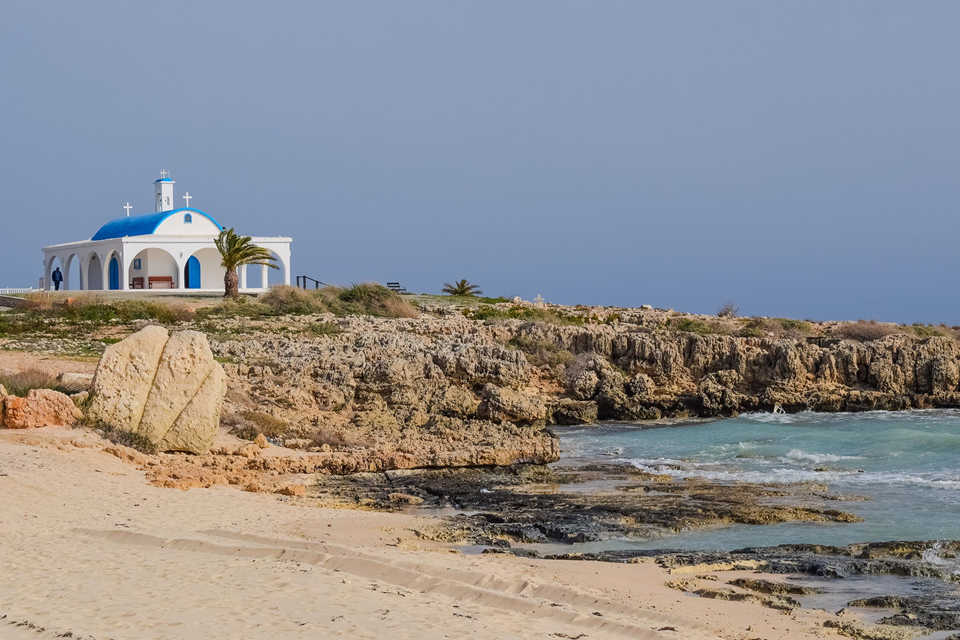
Three kilometers outside of the town of Agia Napa the little chapel of Agia Thekla, built, some believe, at the site of an ancient settlement or graveyard, sits on top of a table of rock a couple meters high. Just west of the chapel and cave, or, as some call it, catacomb, there are indications that there was a quarry where stone was mined in antiquity.
A ramp of paved stone, parallel with rock steps, curves down and around to a squared-off opening in the rock, and the cave of Agia Thekla. A stone-paved path continues from the cave several meters to a beach of rock and the waters of the sea. Further along the water’s edge is the 300-meter, sandy Agia Thekla beach, one of the more popular in the area. The church has a painted blue barrel-vault roof and is surrounded on three sides by a wide, arched portico. It’s a remote and beautiful spot, open to the winds and often buffeted by them.
Agia Thekla was a young woman from Asia Minor who was converted after hearing the Apostle Paul preach in the middle of the first century, AD. She is said to have been so impressed by the words of the Apostle that she” forgot to eat and drink and partake of that which sustains life,” says her biographer, 5th century Bishop Vasilios of Caesarea. The good bishop goes on to say that she “even forgot her mother, and her fiancée, both of whom had tried to prevent her from hearing Paul speak.” He then says that, unable to attend the Apostle’s message, see was able to hear it from her window, and, hearing it, she remained motionless and speechless for three days.
After that she announced the breaking of her engagement, and her total dedication to God. Then, the story goes, her fiancée, blaming Paul for the breakup of the engagement, had the Apostle imprisoned. As for Thekla, she was condemned to be burned to death. However, as the flames coiled around her body, they went out all by themselves. Paul had in the meantime gotten released from jail and had moved on to Antioch, Syria, to which place Thekla followed him. There one Alexander, ruler of the city, fell in love with her, but she wasn’t interested. He grabbed her one day in the street to kiss her, but she ripped his clothes. After this public embarrassment Alexander condemned Thekla to live her days out as a nun, which is what she had wanted to do all along. Tradition says that she followed Paul on his missionary trips, which is how she got to Cyprus.
Whether she lived in the cave near the chapel or not is debatable, since her official biography states that she lived her days out in a cave in Syria, and was buried there. Her burial place was a destination for pilgrims until 2013, when Syrian Islamic rebels destroyed the shrine and scattered her bones to the four winds.
Thekla is commonly known as the “Eisapostoli,” or equal to the Apostles, for her devotion to Christ during the early years of the church. Thekla is said to have worked many miracles in her life, including the taming of wild animals. Her feast day is the 24th of September.