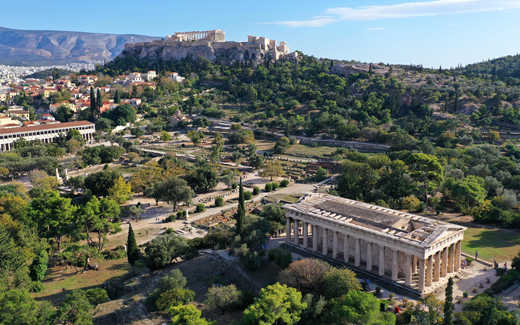
If you stand near the Porch of the Maidens of the Erechtheum, on the northwest edge of the Acropolis, and look a bit further to the northwest, you'll see, two-hundred meters away, rising out of the greenery of pines and spear-like cedars, a bald, lumpy-surfaced outcrop of rock about thirty meters lower than the spot on which you are standing. Most days you'll see anywhere from a handful to dozens of people making their shaky way across the surface of the rock, using their hands as well as their feet to navigate its slippery-smooth contours.
If you go down to the base of this outcrop, you'll see, just to the right of a narrow staircase carved out of the living stone and leading some ten meters to its summit, a bronze plaque commemorating the visit to this place of the Apostle Paul in the summer in the middle of the 6th decade of the first century. The plaque has the entire text of the "Mars Hill Sermon," from the seventeenth chapter of the Book of Acts, in which Paul stood before the Supreme Court of Athens, the Areopagus: 'Ares' ('Mars' is his Roman name), and 'Pagus'- 'hill,' and made a defense of his faith before the assembled wise men.
A logical person, after scrambling around on the lumpy surface of the rock, would think: "How in the world could a court of law sit up on this rock comfortably and hear cases?"
It's a good question, and the answer is: it couldn't. Yes, the fact is, what we now call Mars Hill is only the highest promontory of a little escarpment which runs to the west of this point, gradually losing altitude, until, above what was once the teeming streets of the Agora, you'll find, amidst the weeds, thistles and junipers, the bare outlines of stone that has been worked into rough benches. This is almost certainly the true location of the Areopagus.

The modern site of Mars Hill, uneven and hazardous as it is, is still a great place to catch one of the best panoramic views in Athens. On a warm day you can fit your body into the contours of the smooth rock and have a sort of Flintstones-style lounge chair, and sit and sun yourself as long as you want, if you bring something to keep you hydrated.
What exactly was the Areopagus? It began as a council of aristocrats who advised the king beginning in the early Archaic Period, (the mid-7th century, BC). They considered themselves guardians of Greek law, and had significant veto power over the Voule, the general assembly which proposed and enacted various statutes. Its most serious duty, however, was that of a murder court.
This role as a murder court, Demosthenes says, has its origins in mythology; he claims that the god of war, Ares, was put on trial on the Areopagus for the murder of a son of Poseidon.
The members of the Areopagus were all former Archons. The Arcons were leaders in Athens, there were three, and its members were selected from the aristocracy by elections held every ten years. At the end of their terms of service they automatically became members of the Areopagus. The appointment was for life.
As a side note, to this day the Greek Supreme Court is called the Areopagus.