An ancient haven dedicated to Asclepius, the Greek demigod of medicine, the Asclepieion of Kos (also written “Asklepieion” or “Asklepion”) commands attention despite being a shadow of its former glory. A roughly 1.5 km drive southwest from the quiet village of Platani and 3.5 km from Kos Town (namesake of its island), it nests on the side of a low hill shrouded by wild cypress trees native to the Dodecanese. Their sacred wood comprises Asclepius’ snake-entwined rod, a famed symbol of healthcare even in the modern age. This monument offers a view of the Ceramic Gulf and south-western Anatolia which is nearly stunning enough to distract from its rich, Greco-Roman history.
In ancient times, the Asclepieion was not only used for worship and healing. It was also a driving force for the scientific progress of medicine. This should come as no surprise, as the Father of Western Medicine himself, Hippocrates of Kos (c.460 – c.370 BC), founded a school within the Asclepieion. Both doctor and philosopher, he focused on predicting disease and the development of symptoms by placing emphasis on mental health, balanced eating, and exercise.
Perhaps the thing Hippocrates is most widely known for is the Hippocratic Oath, which famously includes a vow to do no (intentional) harm. Modern medical school graduates still sometimes swear to a version of this. Another thing you might know Hippocrates for is his adages, such as “let food be thy medicine and medicine be thy food” and “science is the father of knowledge, but opinion breeds ignorance.” He also said that “walking is man’s best medicine,” something which you yourself might attest to as you walk the grounds of the Asclepieion as he once did.
Winning TripAdvisor’s Traveller’s Choice award in 2022, the Asclepieion is a must-see if you’re planning on visiting the beautiful island of Kos.
The Buildings That Were
As you stand at the top of this three-terrace structure, amidst the ruins of what was once Asclepius’ grand Doric temple, you have the former rooms for patients and worshippers at your back, just beyond the Π-shaped series of porticoes. Here, you overlook all that has been excavated of Kos’ most renowned archaeological monument. Below and to your right, on the middle terrace, you would have once seen a red-roofed, Corinthian temple dedicated to Apollo, father of Asclepius. It was built sometime in the years 138-169 A.D. and nestled between a lesche – a building used for conversation – and an altar to Asclepius built in the style of that at Pergamon, which was dedicated to Zeus.
Opposite the imposing, marble steps, to your left, stood an Ionic temple to Asclepius, smaller than the one at the top, beside which were the priests’ personal chambers. In this temple, pilgrims and patients gave offerings to Asclepius, his son, Machaon, and his daughter, Hygieia, the goddess of health and cleanliness whose name means “health” in Greek. It boasted several works by Apelles, a great Hellenistic painter who flourished during the 4th century B.C. and whose reach did not end with his death. Centuries later, he inspired many painters of the Renaissance, including Sandro Botticelli and, arguably, Raphael. Among these was a painting of Aphrodite rising from the sea, taken by Augustus to his Temple of Caesar where the Romans called her Venus. Hence, the painting is known today as Venus Anadyomene.
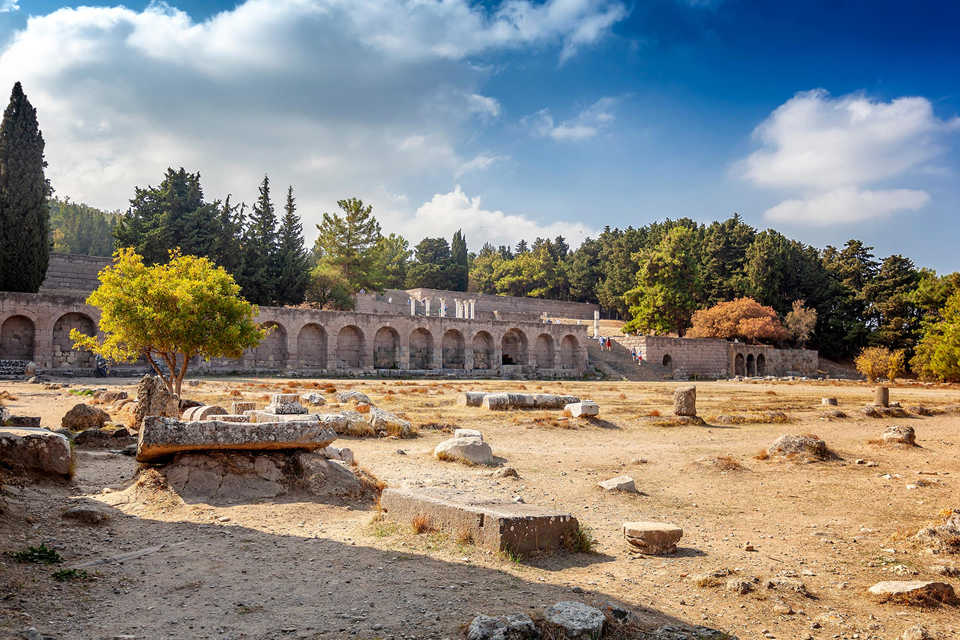
Built into the wall connecting the middle and bottom terraces, on your right, a series of alcoves has survived the test of time. Here, statues of the gods, as well as water tanks and thermal fountains used for hydrotherapy made their home. One of these springs is still visible today. Water was drawn from two sources: Kokkinonero (named “red-water” after its colour) and Vourina, the latter of which continues to supply the town of Kos. Across the stairs, to your left, you can see a single alcove containing a temple to Asclepius, his wife, Epione,and their daughter, Hygieia. It also appears to be dedicated to Emperor Nero. It was offered to the Asclepieion by a Kos native, Gaius Stertinius Xenophon, who served Emperor Claudius as a physician during his reign from 41 to 54 A.D. and is suspected to have been involved in his death.
Directly before you, on the bottom-most and largest terrace, you would have found the entrance to the Asclepieion. The first flight of stairs would have led to an awe-inspiring, four-column propylon surrounded by another series of porticoes. These mirrored the Π at the top and are believed to have housed pilgrims, the ill, and athletes that came to compete in Asclepieian festivals. It is thought that the terrace’s empty space was used during these festivals, which included athletic games and musical contests that were held once every four years beginning in 242 B.C. To your right, you can see what remains of the thermae (Roman baths) dating back to the 3rd century A.D.
Parking and Café
There is a free car park roughly 200 meters away from the monument, as well as a café where you can sit and eat snacks while sipping on an assortment of frozen drinks, iced coffee, fresh orange juice, and more. You will also have the opportunity to buy souvenirs so you never forget your trip to Asclepius’ sanctuary.
Information
- Phone number (+30) 22420 28326
- E-mail address efadod@culture.gr
To reach the Asclepieion, coming from Kos Town, follow Asklipiou Street until it branches off into Agiou Dimitriou Street. Follow Agiou Dimitriou Street until you see the road leading to the car park.
Tickets
- Full entry fee is €8
- Reduced entry fee is €4
You must carry proof of identification so the staff can determine which price you qualify for.
A special ticket package priced at €15 is valid for the Asclepieion of Kos, the Archaeological Museum of Kos, and the Casa Romana (Roman Villa). This package lasts for 3 days. Tickets may be purchased at all three sites. Please note that information such as open/close times and dates might differ between the three attractions.
Free and Reduced Admission
EU citizens aged 6-25 are entitled to free admission.
Reduced admission is granted to people over 65, non-EU citizens aged 6-25, and everyone visiting during winter (1 November to 31 March).
Free Admission Days for All
Free admission days include 6 March (in memory of Melina Mercouri), 18 April (International Monuments Day), 18 May (International Museums Day), the last weekend of September annually (European Heritage Days), and all Greek national holidays.
Dates and Times
During summer (1 April to 31 October), the Asclepieion is open daily from 8:00 to 20:00. During winter (1 November to 31 March), it is open every day but Tuesday from 8:30 to 15:30.
It is open from 8:30 to 15:00 regardless of season on 6 January, Shrove Monday, Holy Saturday, Easter Monday, Holy Spirit Day, 15 August, and 28 October.
On Good Friday, it is open from 12:00 to 15:00.
The monument is closed on 1 January, 25 March, 1 May, Easter Sunday, 25 December, and 26 December.
Please note that all religious holidays are in accordance with the dates designated by the Orthodox Church, not the Catholic Church.