(For this article “Plateia” and “Square” are used interchangeably.)
Monastiraki, with its bustling Flea Market, is arguably the busiest, liveliest, most interesting corner of Athens. You could start at one end of Monastiraki, near the Monastiraki Metro station, walk through it, and by the time you come out at its east end near the Thiseio Metro station, you will have been able to buy everything you would need to fully stock an empty house, garage, and workshop, and much of it would be antiques.
The 500 meters of Metro tracks between the two Metro stations form the southern boundary of Monastiraki, with its northern boundary being Ermou Street, 125 meters to the north. This creates a compact, rectangular area packed with shops selling antiques and novelties, jewelry, used books, tools and hardware, agricultural implements, used parts for motorbikes (the latter famous for its chopped-up stolen bikes), furniture shops, art galleries, and the ubiquitous tourist shops. Here and there are little fast food stores selling souvlakia, gyros, and other typical carry away Greek treats.
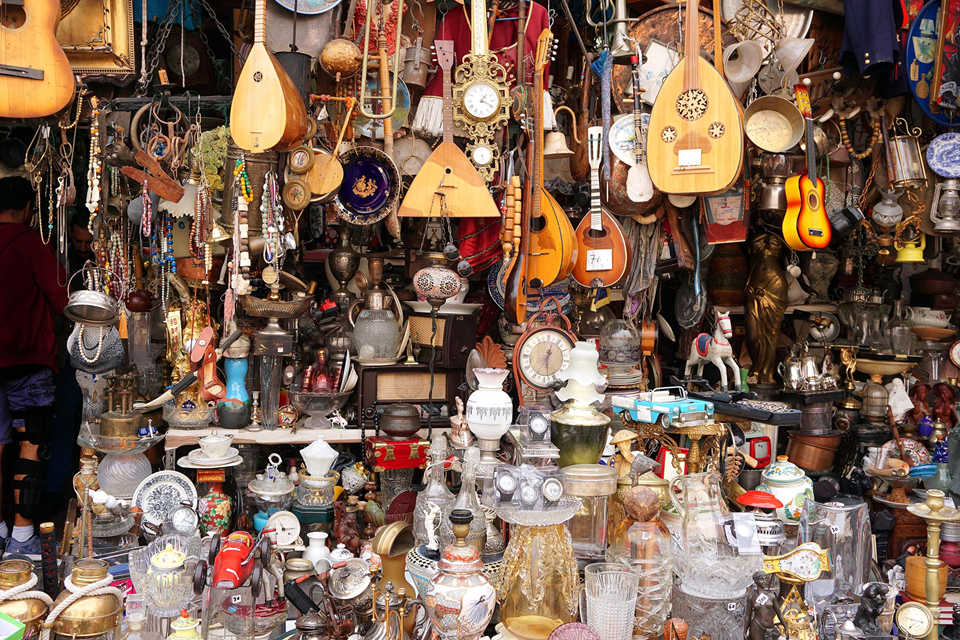
It’s not exactly a flea market, except for Sundays, when sellers of knick-knacks of all kinds flood the area and make it even harder to find space to walk. Some years back the crowds had gotten so large, especially along Ermou Street on the north, that the police had to clear out the junk and knickknack dealers, most of whom had no permits to sell on the streets anyway. Monastiraki has been likened to a smaller version of Istanbul’s Grand Bazaar, and it’s a fairly apt comparison. It’s colorful, noisy, and endlessly interesting.
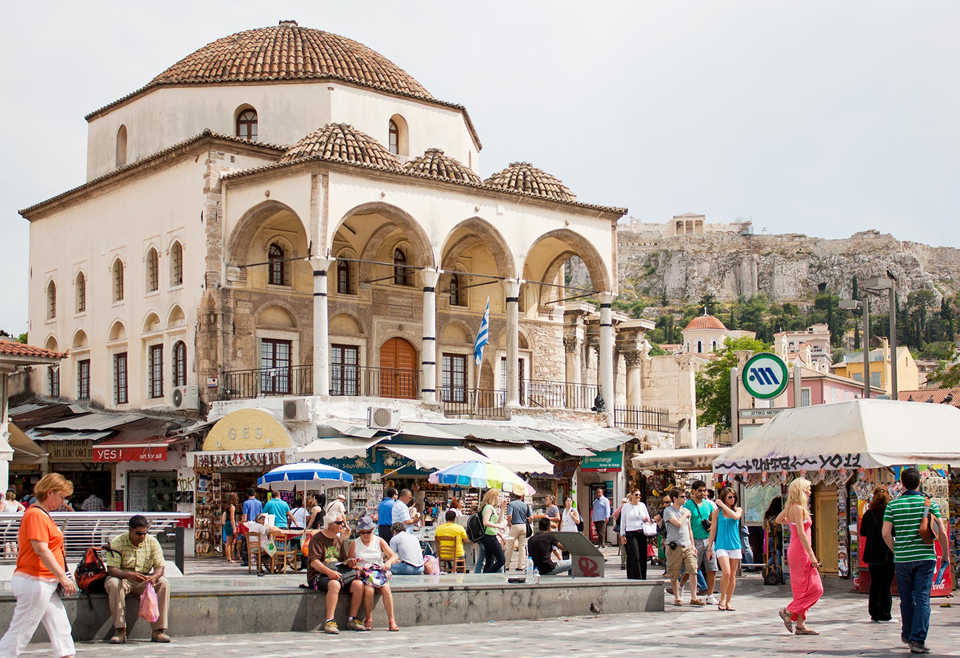
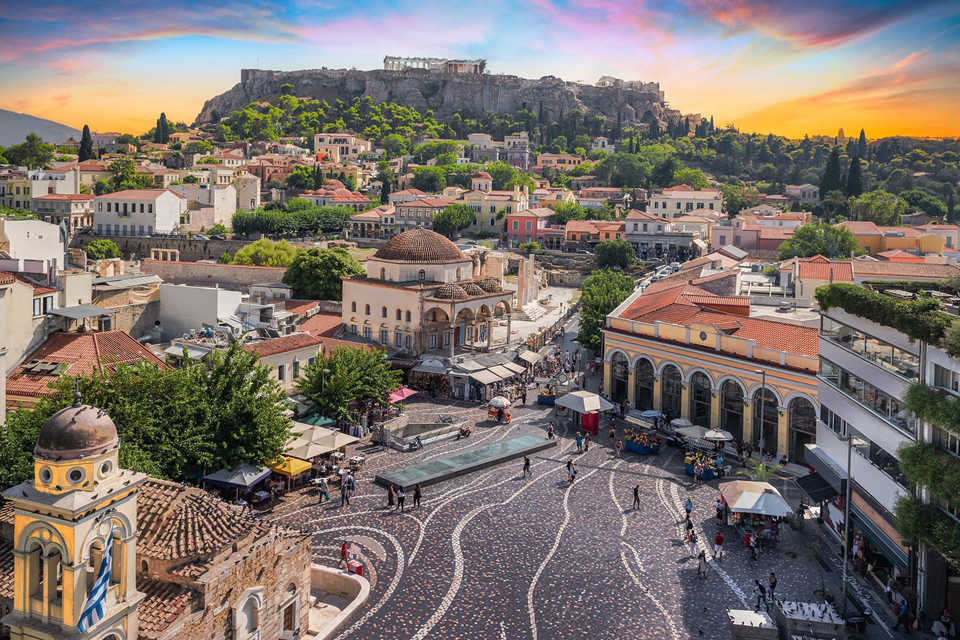
Foot traffic flows into the district from Monastiraki Square and the Metro station at the east end of the Flea Market. Monastiraki Square, a pentagon-shaped open area approximately 70 meters north-to-south and 50 meters east-to-west, is defined by four buildings: The Church of the Pangia Pantanassa, the Tsistarakis Mosque, Hadrian’s Library, and the Monastiraki Metro station.
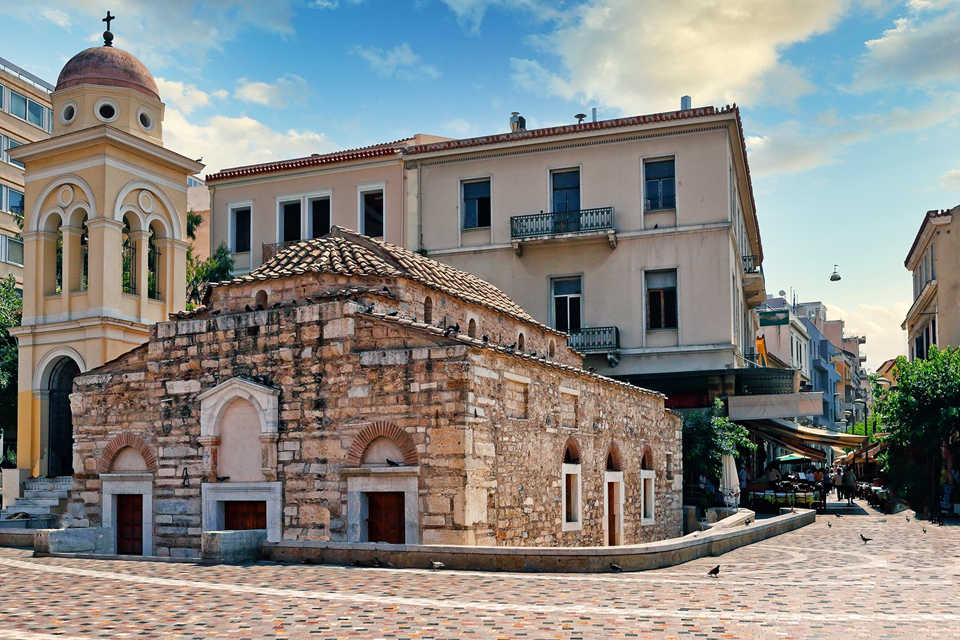
The Church of the Panagia Pantanassa (of of the Dormition- “Falling asleep-”of the Virgin Mary), on the east side of the Square, was once part of a larger monastery. Recent excavations for the Metro have uncovered floor mosaics dating from the 5th century and some foundations of nearby shops or houses. The monastery was referred to as the “Big Monastery” during the 17th century. The bell tower was a relatively recent addition, dating from 1911. It was one of Athens’ most important places of worship. After extensive changes took place in the late 19th century, when many of the outbuildings of the monastery were torn down, partly to make room for the 1895 construction of the Metro station, it was known as the Monastiraki, or “Little Monastery.” The cells of the monastery had been built on what is now the open area of the Square. The church’s foundations are well below the level of the Square, and is surrounded by a low protective wall.
Near the southern point of the Square is the Tsistratakis Mosque, dating from 1759 and now serving as one of the locations of the Greek Museum of Fold Art, housing a collection of pottery. The mosque was named after the Ottoman governor of Athens, who supervised its construction but then lost his job went it was revealed that he had ground up columns from the next-door Hadrian’s library to provide lime for the mosque’s construction. The objection was the use of a pagan structure to build a Muslim holy building. The mosque’s minaret was torn down after the 1821-32 War of Independence. The domed building has a triple-domed porch supported but four columns and three arches.
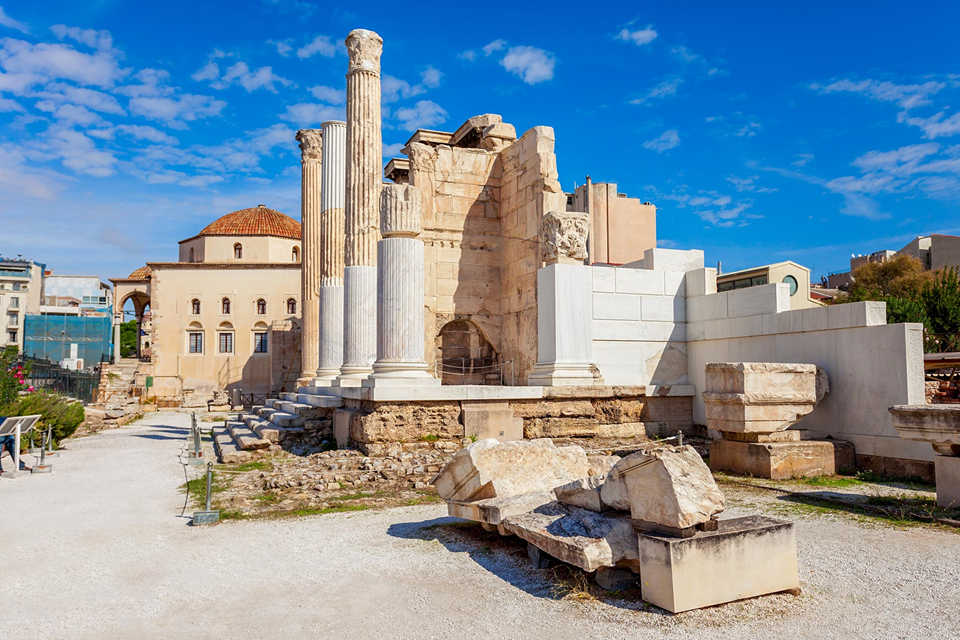
Hadrian’s Library, which abuts the mosque to its south, is directly across the street from the Monastiraki Metro station. Dating from 132 AD, its west wall has seven projection Corinthian columns. Its interior was noted for its oblong pool in its center, around which was storage space for scrolls, reading rooms, and meeting/conference rooms. The Roman emperor Hadrian was noted for his Philhellenism, and sponsored a number of construction projects in Athens and throughout the Roman Empire.
The Monastiraki Metro Station, dating from 1895, is the oldest train station is Athens. It served the route from Athens to Pireaus, 6km south.Renovated when added lines and levels were built during the early 2000’s, it is a neoclassical, mustard-colored gem, with white trim, and arches and pilasters decorating its exterior and a clock face set in its upper wall.
But its most interesting feature has nothing to do with Metro trains, or stations. It is what was uncovered during the process of digging down four levels during the 1990’s in order to create one of Athens’ chief local rail transport hubs (besides the original south line to Pireaus, there’s the north line to Kifissia, and east and west lines which connect.
At about the same level as the original Metro tracks- maybe five meters below ground level- is an excavated exhibit of the Eridanos River, a small stream, really, with its source at nearby Lycavittos Hill, Athens’ highest point. There are a number of pictorial diagrams on the wall opposite the exhibit, and a Plexiglas-paved walkway showing the arched cover constructed during the Roman era, with surviving walls of shops on either bank of the stream, with water flowing out of its southern end. The Eridanos watered the ancient Athens Agora,, crossing it at a diagonal and eventually flowing into the larger Ilissos south of the Acropolis, where it emptied out into the Saronic Gulf 4.5km to the southwest. From about November to May the water of the Eridanos flows through the Keramikos Cemetery NW of Monastiraki some 600m.
You enter the Flea Market from the Square on a tight little lane called Ifestou, after walking past the fruit and nut sellers who often park their push carts in front of the Metro station. After passing the myriad small shops and picking up everything you need to furnish your house and garage, you come, after a few hundred meters, to tiny Plateia Avissynias (also known by its Turkish name, Giousouroum), ground zero for the Sunday flea market. Hundreds of people selling thousands of used objects crowd its narrow confines. With people jammed nearly cheek to jowl, it is a place to find almost anything, and to soak in the loud, lively atmosphere of a thriving bazaar.
Later, you can take your purchases a few more meters down Ifestou to the little St. Phillip’s Plateia which has, as its centerpiece, the Church of the Apostle Phillip. There you can have a seat, enjoy a frappe or a meal of gyros, salad and beer, or a bit of ouzo and mezes (appetizers or finger food), and watch the world go by. At regular intervals the metro train, down below street level, heard but not seen, rumbles by, carrying passengers towards Piraeus or Kifissia, and points in between.
Monastiraki is a great place to people watch, to buy, and to enjoy Athens’ salubrious climate. It’s close to other tourist attractions, such as the Acropolis and ancient Agora, and the metro line is just a minute away should you decide to remove yourself to some other tourist attraction in the Greek capital.
Monastiraki, Athens