Athens can be a pretty interesting place, but let's face it: Athens is a big, sprawling, chaotic, often smog-bound place where your day is not complete if you do not have to jump out of the way of a motorbike bearing down on you on a crowded sidewalk, or if you do not see at least one top-volume argument, whether between a storekeeper and a customer, two people arguing politics in a public square, or a couple of frustrated motorists trying to navigate streets which resemble arteries so clogged by arteriosclerosis that you are sure the city will die of gridlock.
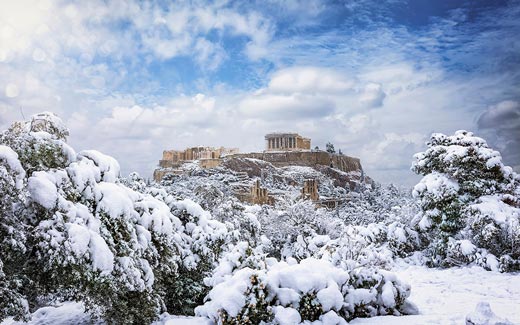
Amidst all of this sturm und drang, in the shadow of the Acropolis, lies a quiet oasis closed to most traffic except delivery vehicles, and dotted with surprisingly serene little nooks and corners, included some tiny plazas shaded by mimosa and jacaranda trees.
If you go to Google Earth and zoom into its bird’s-eye view of the Athens city center, you'll see a band of red-roofed buildings off the east end of the Acropils, which curve, comma-like, around to parallel the longer north part of the rock. Those red roofs mark the much lower, older, tile-topped buildings of the Plaka.
Its nickname is the "Neighborhood of the Gods," because it lies so close to the Acropolis. No one is certain beyond a reasonable doubt about the origin of the name, but the front-running theory is that it is derived from "Pilak Athena," which means "Old Athens" in Arvanitika, a dying Albanian dialect. The Arvanites had migrated south from southern Albania and northwestern Greece during the 19th century, before Athens became the capital of newly-independent Greece in 1833. Athens at that time was little more than a large village of some 4,000 souls, with the Plaka being the best residential area.
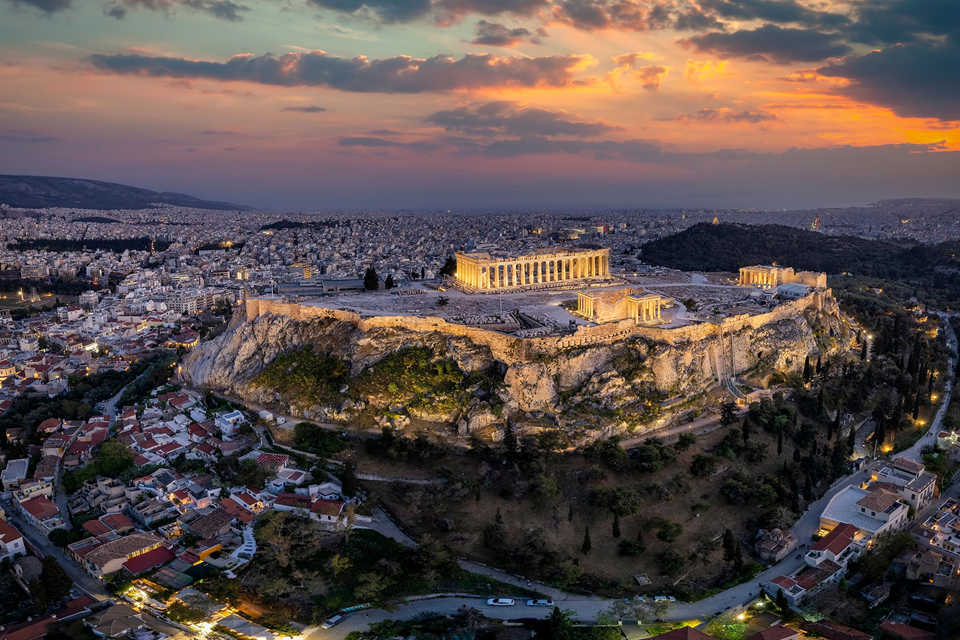
If you were to remove all the buildings of the Plaka- most of them date from the 19th century-and then start excavating, you would eventually uncover a warren of houses and narrow streets comprising the chief residential district of the ancient polis. If you would like to know what that would look like, hie yourself over to the state of the art Acropolis Museum just a few hundred meters to the south, where the chief reason it took so long to build was that excavations for the building's foundations uncovered a similarly densely-built neighborhood.
The end result was that plans for the building to be constructed at ground level were scrapped. The whole museum was elevated on concrete piers, leaving the ruins of the ancient neighborhood excavated, intact, and visible, several meters below grade, through the thick Plexiglas which has been used to pave the museum's extensive forecourt.
Curving through the axis of the Plaka and dividing it into upper (closer to the Acropolis) and lower halves is Plaka's main thoroughfare, Adrianou Street. As it splits the neighborhood lengthwise, it creates a banana-shaped Upper Plaka which clings to the lower elevation of the Acropolis and more closely follows its curve, and a more traditionally spider web-shaped-shaped Lower Plaka north to where the red tile-roofed classical buildings stop at the massive Metropolitan church of Athens, home to the funerals of Prime Ministers and other public figures. To the east the boundary is Hadrian's arch.
The Ottoman governor had his official residence in the Plaka, and the area was called the Turkish Quarter during those centuries. After the war of Independence, the Turks left and the Arvanites moved in. Athens grew rapidly after independence was gained. The quaintest architectural artifact from this time is a group of forty five houses snuggled right up against the sheer face of the Acropolis. Anafiotika is so-named because the house builders were from Anafi, a tiny Cycladic island with a present population of only 300.
The Anafiotes were stone masons who had come to help build the palace of King Otho, a building on Syntagma Square which now houses the Parliament.
Some Things to See
Among the too-many-to-count small establishments selling "touristika skoupida (tourist junk)," lie some very pleasant surprises: there is the Brettos, Athens' oldest distillery, with its mesmerizingly backlit floor to ceiling shelves and glowing multi-colored bottles of seemingly every alcoholic beverage known to man.
There is the ancient Monument to Lysicrates, lone survivor of the monuments which once lined Odos Tripodon (Street of the Tripods) and hearkening back to the days when drama was born and flourished 500 years before Christ. The monument to Lysicrates dates from the 4th century, BC and commemorates the patron of the prizewinning play in that year's Dionysian Festival drama competition. It is the centerpiece of an excellent little plaza or platia, with a few well-shaded benches just to its south and some low-profile, quiet cafes off its borders. There is the Byzantino Tavern and Restaurant, a favorite of locals and ex-pats, on Kydatheneon Street, with its excellently prepared simple Greek fare and some of the best wait service in Greece.
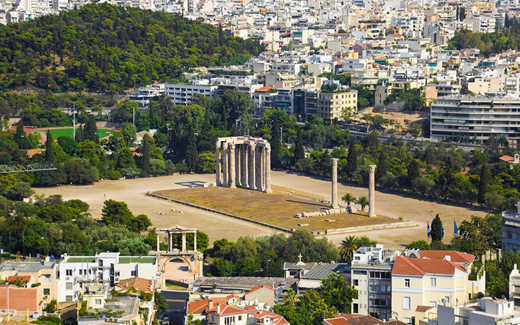
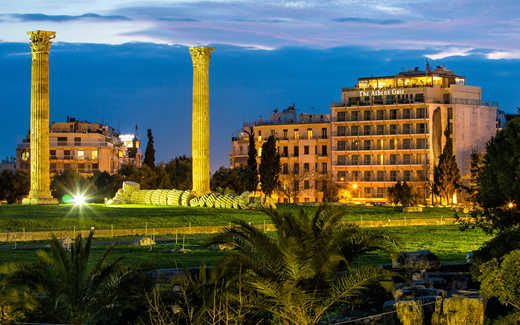
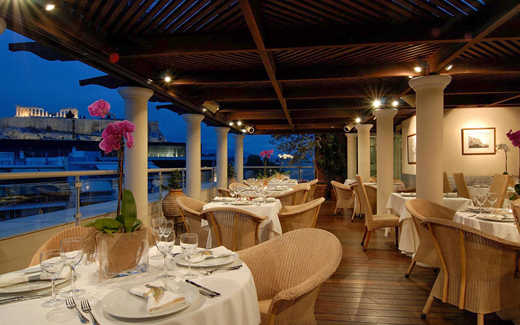
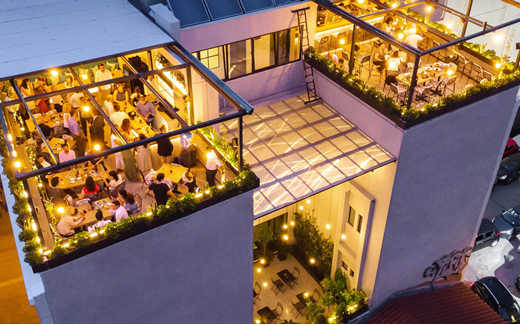
You can visit the Garden Rooftop of the Athens Gate Hotel, on the eastern margins of the Plaka, across the street from Hadrian’s arch, for refreshments and one of the best, uncluttered panoramic views of the Acropolis, the temple of the Olympian Zeus, and most of downtown Athens.
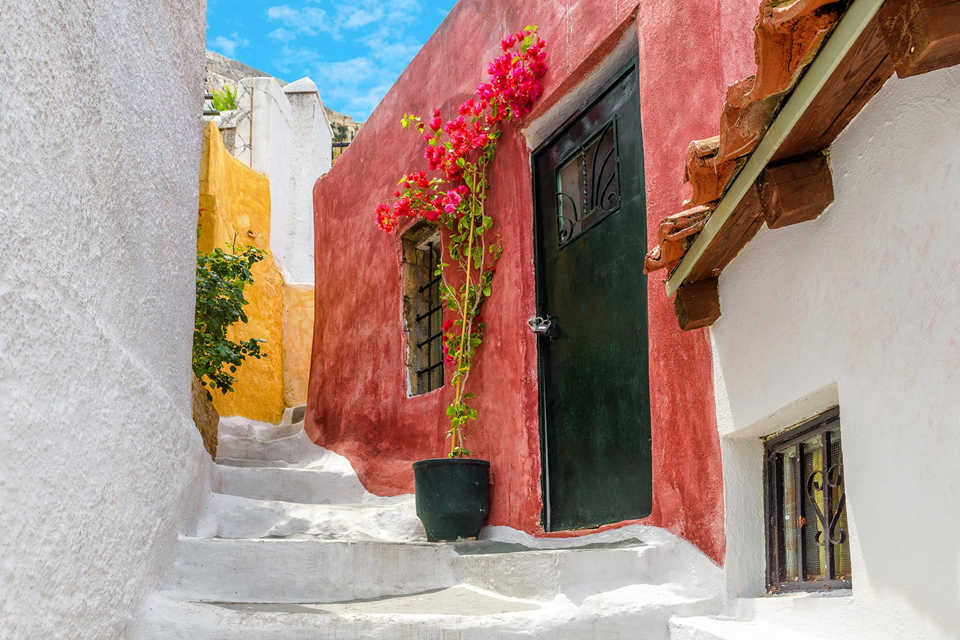
Don’t forget to explore that tiny, cubic, white-washed Cycladic-style houses of Anafiotika (see above), whose residents have to park well below the mini-neighborhood and pack their food in on foot. Just as in the Cyclades, there are a lot of cats lazing around on the plastered walls demarcating property lines, trellised bougainvillea and grape vines, extremely tight, narros little lanes lined with potted tropical plants, and an uncanny peace and quiet that is nothing like the bustling city which surrounds it.
About seventy meters downhill of Anafiotika is the 11th century Agios Nikolaos Ragavas Church. When the Ottomans captured Athens, throughout Greece they forbade the use of church bells. Instead, the priest would strike a heavy plank of wood suspended by chains. Agios Nikolaos Ragavas was the first church to re-institute the use of the bell after Greece gained her independence. It was also the first church to ring out the news of the end of the Nazi Occupation on October 12, 1944. It’s a favorite for locals for weddings, and most weekend evenings weddings take place there, especially during the warm weather months.
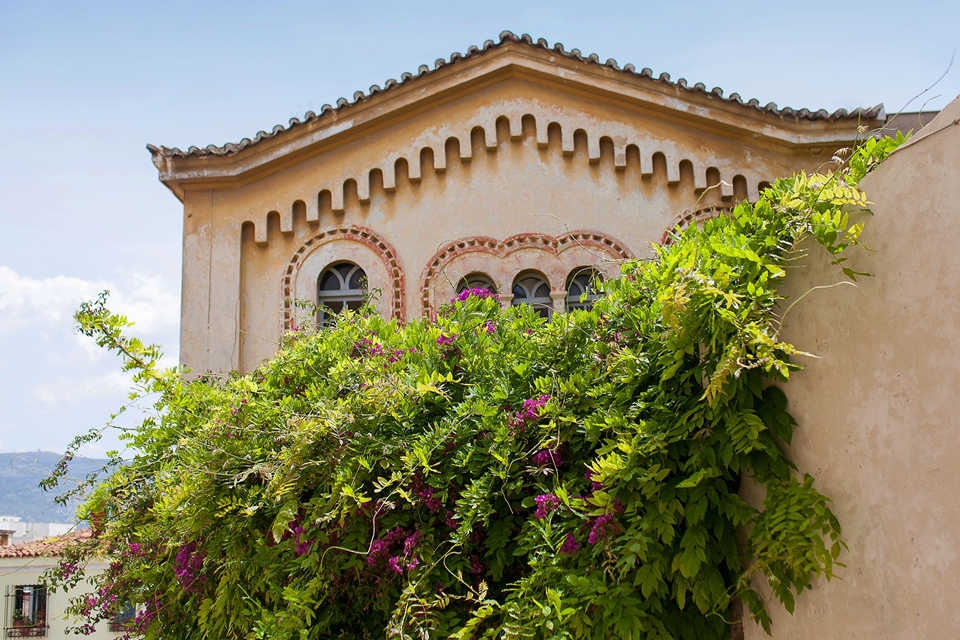
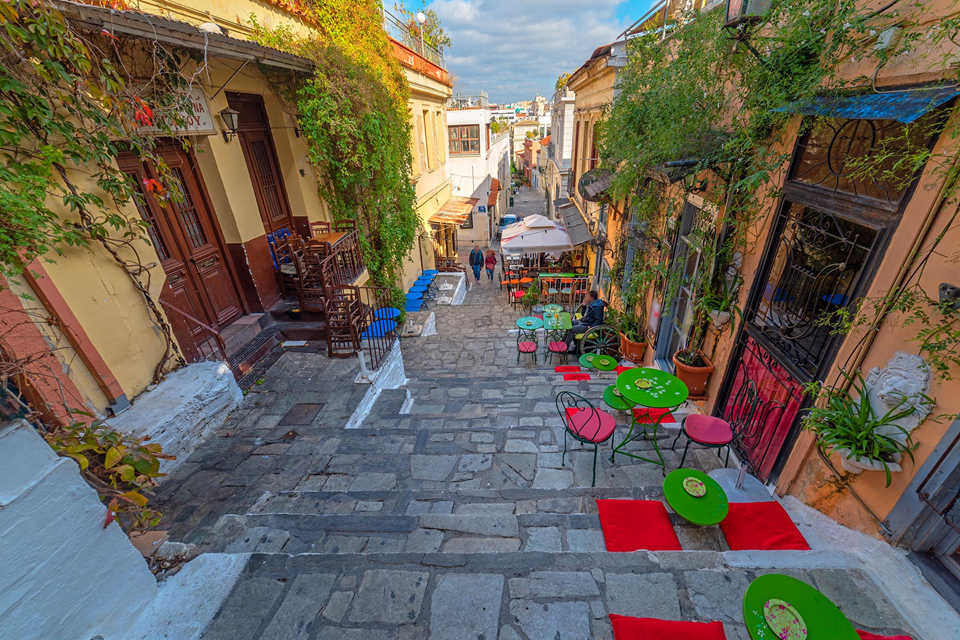
The Plaka Stairs, a favorite subject for postcard photographers, is about 170 meters off the northeast edge of the Acropolis. This long flight of stairs is bordered by several cafes and restaurants, giving you an interesting view of your fellow diners.
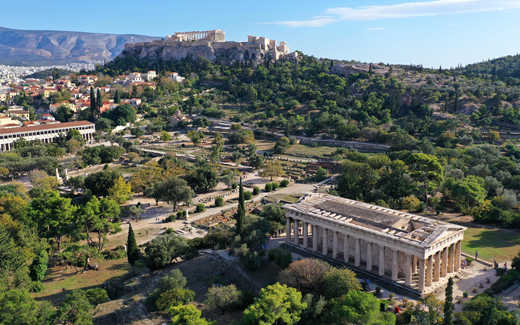
The Plaka has many basement cafes and restaurants, and smaller eateries tucked away in little nooks and crannies of off the main tourist drag, Adrianou. To the west of the Plaka, as the narrow streets continue to curve around, following the contours of the Acropolis, you come to the Roman Agora, Hadrian’s Library, And the extensive ancient Athenian Agora. The Athenian Agora, with its extensive green space, provides a definitive western border to the Plaka. North of the Athenian Agora isthe Platia Monastiraki, the large, neoclassical Athens Metro building, and the Monatiraki Flea Market. a fascinating area of small shops selling just about everything, which will be dealt with in a separate article.