About 3KM northwest of the Acropolis, Plato’s Academy, situated in a grove watered by the Kifissos River, was well out of the crowded precincts of Athens in its day. Now, of course, the site is surrounded by the massive concrete apartment blocks which sprung up willy-nilly with little regard to urban planning during the great migration of Greeks into the capital after the Second World War during which the population swelled from 350,000 to nearly 4 million. The name “Plato’s Academy” refers to both the archeological site, and to the Athens neighborhood in which it is located.
The ruins of the Academy are a kilometer west of the Larissa train station, Athens’ main departure point by rail for passenger service all over Greece. GPS coordinates can be found above for a more accurate location. The present-day location of the Academy comprise a fairly large green space for a city like Athens, which has less green space than any other European capital. The dimensions of this roughly rectangular piece of land are about 500m long and 200m wide. It is laced with footpaths, and is really more of an park than an organized archeological site. There are no markers in the area to tell you what is what.
Speaking of which, one of Greece’s problems is lack of funds to fully preserve and present its archeological treasures, which is a shame considering that it is stuffed with these treasures. The sites of world-changing battles such as Marathon, Thermopylae, and Salamis leave it up to the visitor to figure out troop dispositions and the flow of the conflict, instead of having detailed, guided observation points, public maps, and connected museums. Here’s hoping that as tourism revenues rise, some of that money will be given to the Department of Antiquities to rectify things somewhat.
The Museum
One recent improvement in that regard at Plato’s Academy is the interactive multimedia museum which is located at the northern end of the Academy’s grounds and opened in 2015. The museum, which is free of charge, does an excellent job of carrying the visitor back through time via the use of wall diagrams, illustrations and texts, and several wide-screen high-definition video terminals. To make up for the lack of signage on the Academy grounds, digital reconstructions of the buildings of the Academy as it changed throughout the centuries are exhibited.
History
Akademos was an ancient Greek hero who was credited with saving Athens by revealing the hiding place of 12 year-old Helen (yes, Helen of Troy Helen), who had been abducted by Theseus, king of Athens and even more famous ancient Greek hero (Theseus killed the Minotaur at Knossos, Crete). Akademos was reputed to have been buried in a grove of olive trees on land he owned NE of Athens.
The grove, on the banks of the (now channeled underground) Kifissos River, the chief watershed of the Plain of Attica, was a place of worship of the goddess Athena, and had been since the Bronze Age (around 2,000 BC). Plato’s original school there was originally referred to as the “Groves of Akedemos” later shortened and changed, over time, to the Academy.
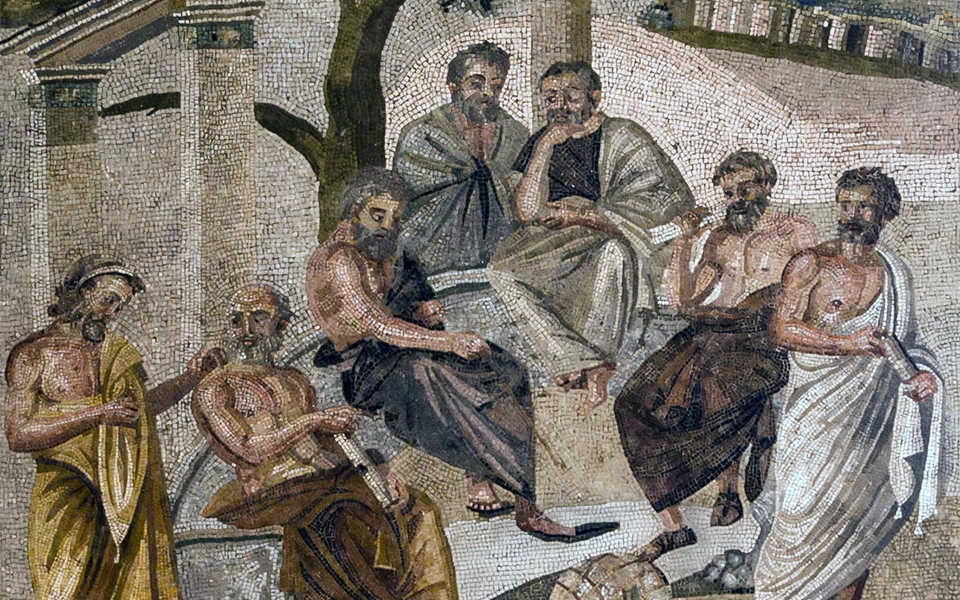
So our modern words “academy” and “academic” come from this mythic hero, and not some root word related to the idea of learning. Akademos left the grove mostly as park land and as a place for gymnastics. The olive trees growing there were said to have come from cuttings from the sacred olive in the Erechtheum, on the Acropolis. It’s oil was said to be awarded to winners of the Panathenaic Games, a religious festival and an athletic and cultural competition held every four years in Athens.
Many centuries later, the land was given to the philosopher Plato as an inheritance when the budding philosopher was about 30 years old. He built a home there, and he founded the Academy in 387 BC. The academy ran in a fairly unstructured, ad hoc way featuring free-form lectures discussions on a variety philosophical topics, and included other, not strictly philosophical topics such as mathematics. A legend has it that a sign over the entrance to the academy admonished, “let no one ignorant of geometry enter here.”
Although there is no direct evidence that there was such a sigh, it is known that Plato believed that philosophers should study mathematics as well as philosophy, because mathematics honed a philosopher’s mind, especially in the area of logic. The idea is that a student ignorant of geometry would also be ignorant of logic.
The most famous student at the Academy was Aristotle, although he was never its director.
The Academy went through three distinct periods during its long history, which ended in the 6th century, AD. During this time there were breaks of a few centuries when it appears that it was not operating at all. The Old, the Middle, and the New periods spanned a total of about 900 years (387 BC-529 AD). The Old Academy covered about the first hundred years, with the names of its five directors recorded, including Plato, founder and first director.
The Middle Academy covered approximately the next hundred years, (266-155 BC), during which the philosophical focus shifted from classical Platonism to Academic skepticism, which is a form of Platonism which held that the truth could not be derived from our senses, so one must suspend judgment in matters of truth and falsehood.
The New Academy began in 155 BC and lasted until the Roman general Sulla cut down the sacred olive grove to use the wood as siege engines against Athens. He destroyed the buildings of the Academy as well, and although various versions of Platonism were taught in Athens thereafter, during Roman rule, but the destruction of the original Academy had been so complete that it did not serve as a ground for Philosophical study until 410 AD. The Emperor Justinian finally closed the Academy for good in 529 AD. Justinian, who is revered as a saint in the Eastern Orthodox church, objected to the paganish teaching of the Academy and suspended activities there. There are stories of members of the Academy stealing away with many scrolls and manuscripts of literature, philosophy, and science, and setting up shop in Harran, near Edessa in Asia Minor.
The modern Academy of Athens is housed in a neo-classical building flanked by statues of Athena and Apollo, the two gods of logic atop high columns with Corinthian capitals, has a columned entrance and a carved pediment above the columns. It was chartered in 1926, and is divided into three disciplines: Natural Sciences, Letters and Arts, Moral and Political Sciences.
The Academy operates several research centers, and a central library. It is also home to the Hellenic Institute for Byzantine and Post-Byzantine Studies.