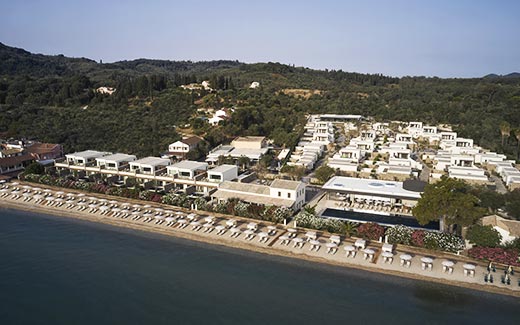
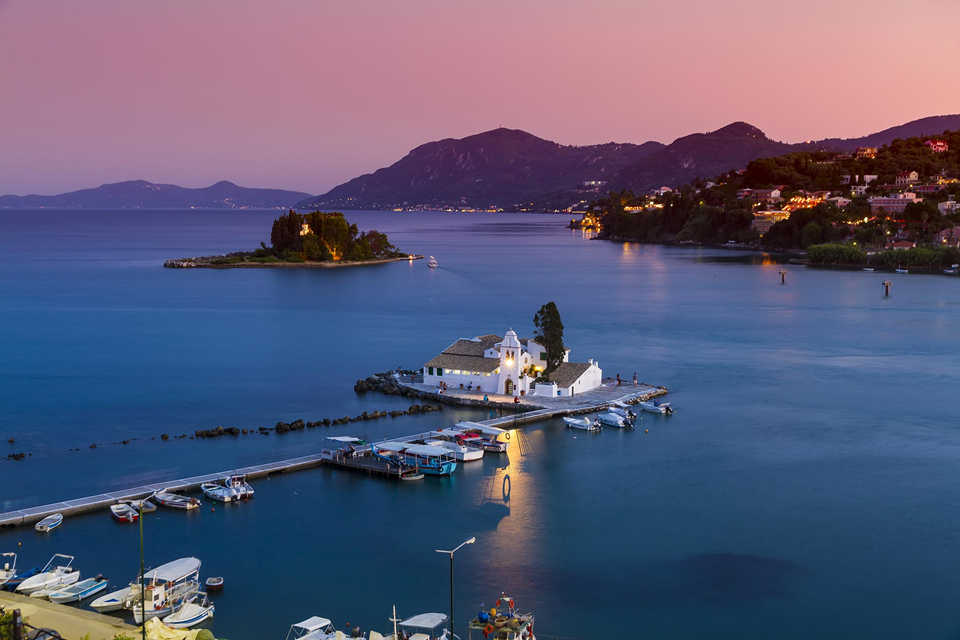
Across the eastern shore of Corfu – from where airplanes pass directly overhead – lies a small, rocky island shadowed by cypress trees whose name is Pontikonisi. There are two theories as to how this island got its name.
The first, which sees the name as a combination of the words “pontikós” meaning “mouse” and “nisí” meaning “island,” states that it was named Mouse Island due to its size and shape, claiming that when viewing it from a bird’s eye view, it resembles a rodent.
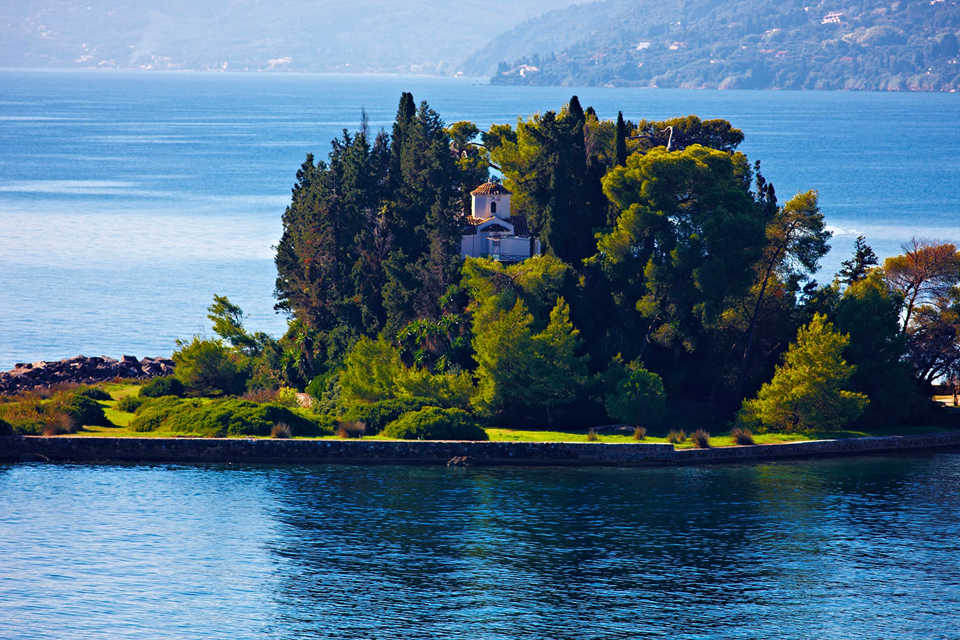
The other theory states that it derives its name from the Pontic monks that arrived here in the 10th century A.D. Lending credence to the latter theory is the fact that the island’s church was erected during the 11th century A.D. This church is dedicated to the event of the Transfiguration of Christ, celebrated on 6 August of every year according to the Greek Orthodox calendar.
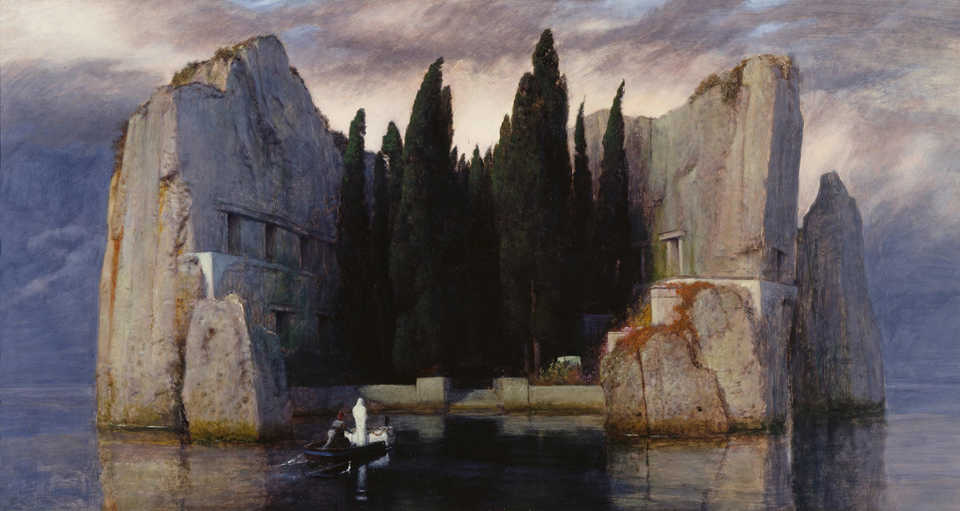
Pontikonisi – which is rumoured to have inspired the “Isle of the Dead” by Swiss painter Arnold Böcklin – is accessible through Kanoni, a neighbouring peninsula containing two tavernas and allowing for a scenic gaze across the water.
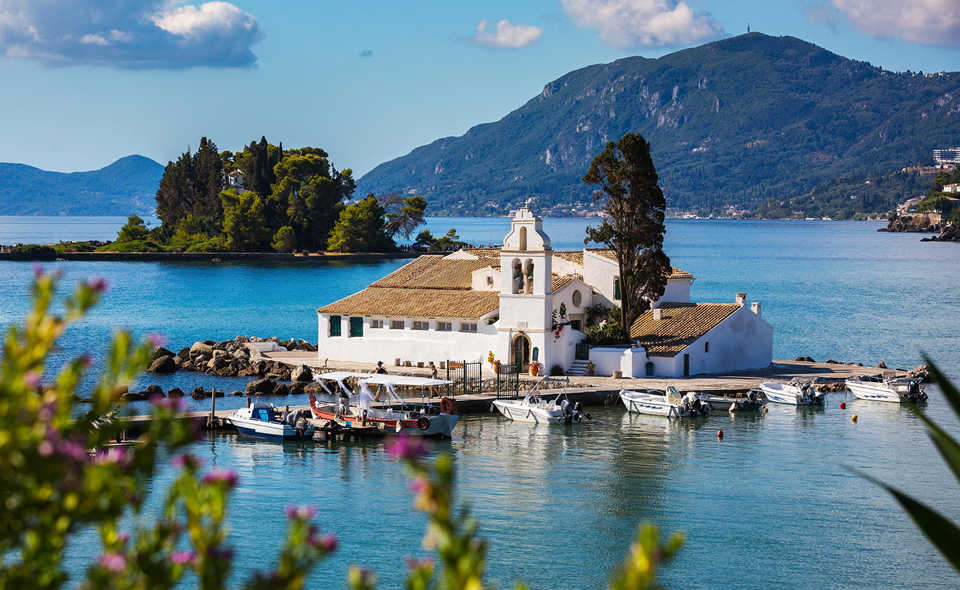
Kanoni allows access to the Holy Monastery of Panagia Vlacherna, which was erected during the 17th century A.D. and holds celebrations every 2 July. From the docks of this monastery, you may catch a ferry to Pontikonisi from 8:30 to 22:30 every day. Return ferries dock on Pontikonisi every 15 minutes. Each trip is currently priced at €2.50.
During the Byzantine period, Pontikonisi was used to watch for invading ships, acting as a strategic location for the emperor’s fleet. In a similar vein, under Venetian rule, structures were built to defend from the Ottoman Empire.
Archaeological finds suggest that it housed inhabitants from as early as the Paleolithic period, which is unsurprising, seeing as Corfu itself housed developed societies from before it became an island, sometime between 10,000 and 8,000 B.C.
It was Homer who described the island’s creation. According to him, Pontikonisi was once Odysseus’ ship, which was turned to stone by the sea god Poseidon as punishment for Odysseus’ disrespect, to prevent him from going home to Ithaka.
Corfu has been subject to many myths and mentions in pop culture, such as the myth of Heracles siring a son, Hyllus, with the naiad Melite, and Shakespeare’s final play, The Tempest, in which Corfu’s influence may be seen in Prospero’s island.
Notably, the Greek film The Countess of Corfu, which is famous within Greece itself, contains a tune about the island, appropriately titled “Corfu, Corfu,” or, in Greek, “Kerkyra, Kerkyra.” Among other beautiful sights, it mentions Pontikonisi by painting a colourful picture with its melody and further cements it as a staple of Corfu.