Nicosia is the only divided capital in the world at present. Its total metro population, both north and south, is 322,000, with the south, at 240,000, accounting for 2/3 of that number. It is a fascinating, vibrant, colorful place, and the closest thing to a metropolis that Cyprus has to offer. In recent years the loosening of travel restrictions have encouraged visits across the Green Line which separates the city.
Capital of Cyprus since the 10th century AD, Nicosia was divided into northern and southern sectors in 1963 because of Greko-Turkish tensions, 11 years before the invasion of the north by Turkey and the subsequent partitioning of the rest of the country. North Nicosia is the capital of North Cyprus, the Turkish rump government recognized only by Turkey and condemned as occupied territory by the rest of the world.
Nicosia has become a financial hub in recent decades, and a 2012 survey rates it as the 5th richest city in the world in relative purchasing power.
History
The area, on the Plain of Mesaoria in north-central Cyprus, shows signs of human habitation dating back to the early Bronze Age (2,500 BC). Greek Achaeans, from the northern Peloponnese, settled the site of Nicosia after the Trojan War (around 1050 BC) and founded the city-state of Ledra. By the 600's BC, Ledra was making tribute payments to the Assyrian empire after its destruction by Assyrian ruler Esarhaddon. Ledra declined in importance over the next 3 centuries, until it was rebuilt and re-named by a man named Lefcos during the 3rd century, BC. The newly named city, Lefcothin, was a farming community.
With the advent of the Byzantine Empire during the first centuries of the Christian era, the small city was called "Lefkosia," which is its current name in Greek. By the 4th century the city was large enough to have a local bishop. Salamis, on the east coast, had been the capital of Cyprus until it was razed by Arabs in 647. The capital shifted to Lefkosia in 965 after Cyprus was re-captured by the Byzantines. The move was made for strategic reasons because it was away from the coasts which were prone to attack. A castle was built, and Lefkosia remained the capital of Byzantine Cyprus until 1191.
The Medieval Kingdom of Cyprus
In 1187, Richard the Lionhearted, on his way to the Holy Land for the 3rd Crusade, invaded and conquered Cyprus because of the ill-treatment suffered by his fiancée and his sister by Isaac Kommenos, the Byzantine ruler of the island. The women had arrived on the island before Richard as part of his fleet, but a storm had separated the ships. Kommenos had tried to kidnap the women to hold them for ransom. He'd also imprisoned a number of Richard's men. Richard laid siege and conquered Lefkosia.
Shortly after taking the island, Richard sold it to the Knights Templar, a French order whose members served as financial managers for the Crusades, and grew rich in the process. The next year it was sold to Guy of Lusignan, a French crusader nobleman whose family ruled Jerusalem from 1186 until he was removed by the Muslims in 1192. Guy ruled Cyprus for 2 years until his death in 1194. The island passed into the possession of Guy's heirs in the house of Lusignan, and the medieval kingdom of Cyprus was established.
The rule of the Frankish Lusignans on Cyprus and over the affairs of Nicosia lasted 300 years, until 1489. Administratively, Cyprus had become a medieval kingdom, with Lefkosia the seat of power for the ruling House of Lusignan. The Lusignan kings built city walls around Nicosia along with several buildings, among them the Catholic cathedral of St. Sophia. The rulers preferred to call the city "Nicosia" for unknown reasons, and the name dates from that time. During Frankish rule the city suffered an occupation and extensive damage by the Genoans in 1374, and by the Mamelukes, a powerful military caste in Egypt, in 1426.
Venetian Nicosia
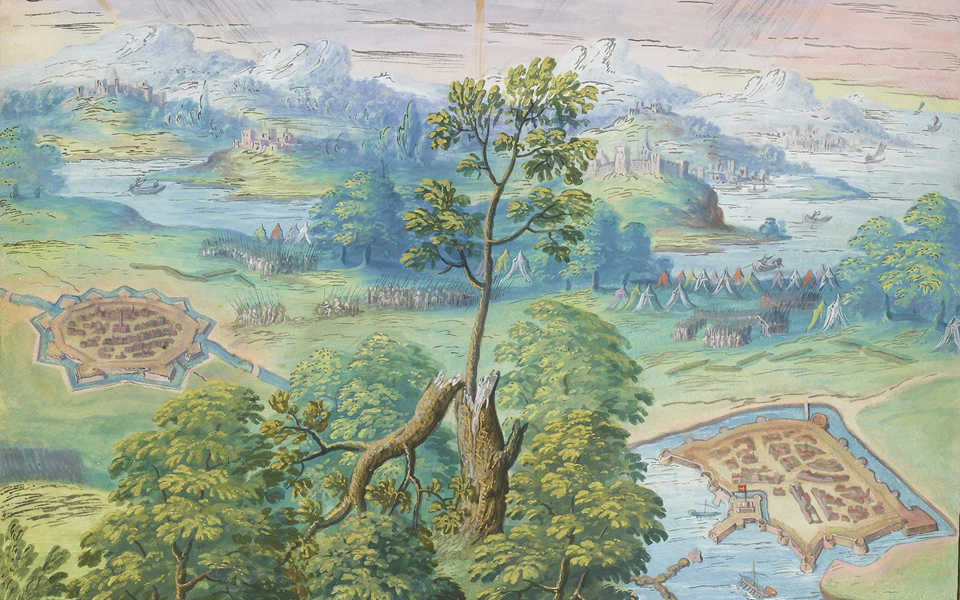
The Venetians came next, in 1489, retaining Nicosia as the capital. Because of the rising power of the Ottoman Turks, the Venetians added to the fortifications of the city in 1567, creating a circular defensive scheme with 11 arrow-shaped bastions projecting outward around the city's perimeter, which made the defenses resemble a gear wheel from above. The Pedieos River, which had flowed through the city, was ingeniously re-configured to flow around the base of the fortifications and serve as a moat.
Ottoman Conquest
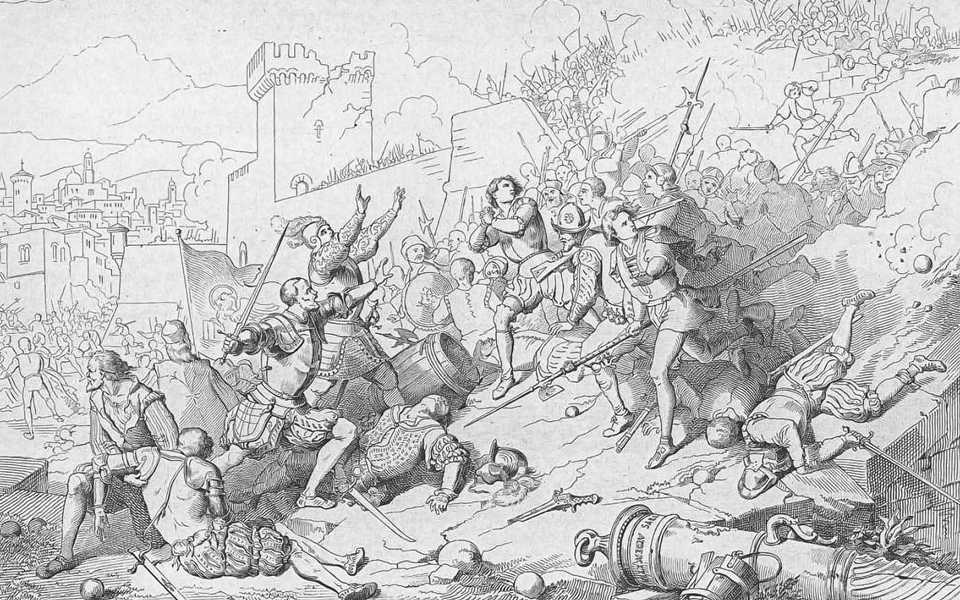
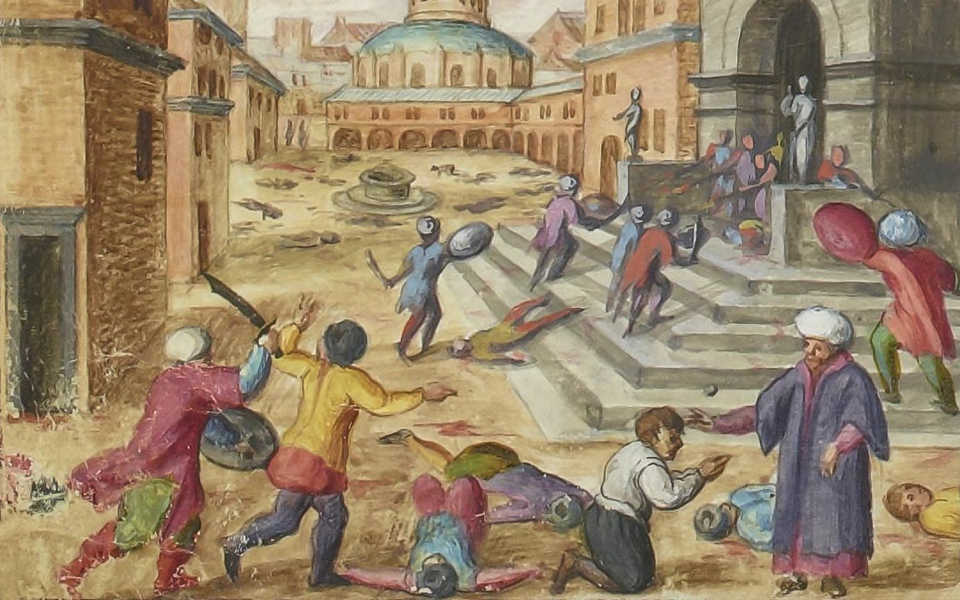
The Ottomans landed on Cyprus on July first. Three weeks later they were on the overland march to Nicosia, having reduced the major coastal cities of Paphos, Limassol and Larnaca. The city fell on September 9th, after a 90-day siege. The Ottomans ended up killing 20,000 Nicosians, looting the town and its churches, and then converting its main houses of worship into mosques. Turkish migrants to the island lived north of the now-dry Pedieos, which had split the city in its east-west flow.
British Rule and Modern Nicosia
The British took over Cyprus in 1878. By 1960 the city's population had quadrupled to 45,000 from 11,000, the city limits correspondingly growing outward in a generally easterly direction. In the middle 50's some Cypriots, who had been lobbying for independence from British rule and union with Greece ('Enosis"), formed the resistance movement EOKA. Their struggles bore fruit with Cypriot independence in 1960. Because there was a large Turkish minority on Cyprus, Enosis was abandoned as unfeasible.
The Division of Nicosia
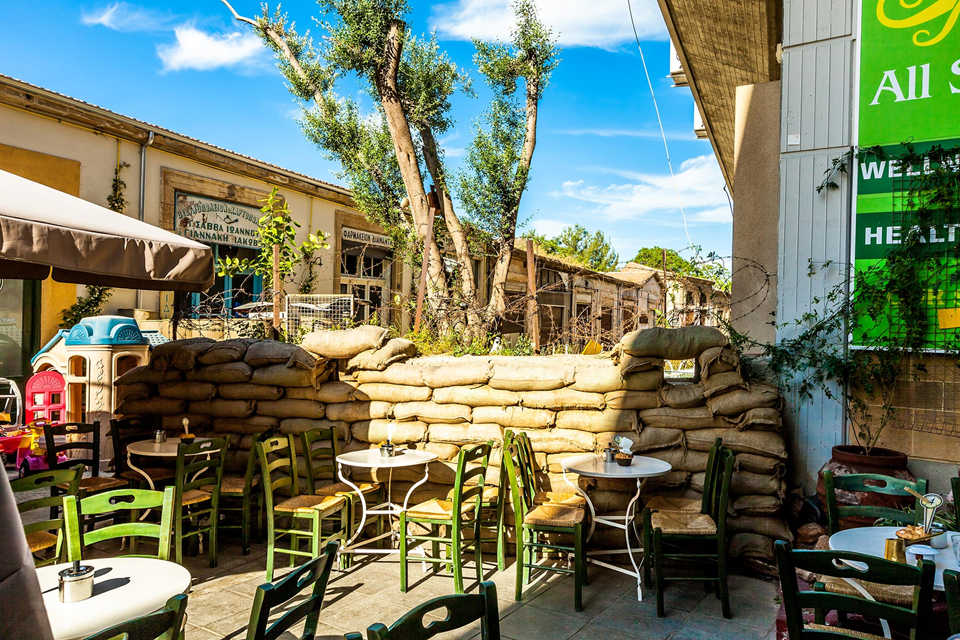
The complicated political and cultural relationship between Turkish and Greek Cypriots became even more complicated when violence between the two factions broke out in 1963. Nicosia was divided into Turkish and Greek sectors by the so-called Green Line, along the bed of the Pedieos. The name comes from the color of the ink used to draw the boundary line on a map by a UN official. The line is not a line at all, except as it exists running down the middle of the UN-established Buffer Zone that is kilometers-wide in some parts of Cyprus.
The partitioning on Nicosia prompted the Turkish members of the Cyprus Parliament to resign, and after some more violence, Turks in south Nicosia moved north of the line. Then in 1974 the ruling junta of mainland Greece tried to force Enosis by deposing Cypriot president Makarios III with a man of their choosing. This triggered the invasion of Cyprus by Turkey and the current partition of the entire island into Greek and Turkish sections.
In recent years 3 pedestrian crossings between the 2 halves of Nicosia have been opened. It used to be much more difficult and complicated to cross the green line, but restrictions have been greatly relaxed. Technically, one is required to pass through some kind of immigration. But practically, especially at the Ledra Street and Ledra Palace Hotel (once Nicosia's most famous hotel, now in Turkish Nicosia) crossings, the Turkish border guards let you walk right through with a simple passport stamp.
The Old City
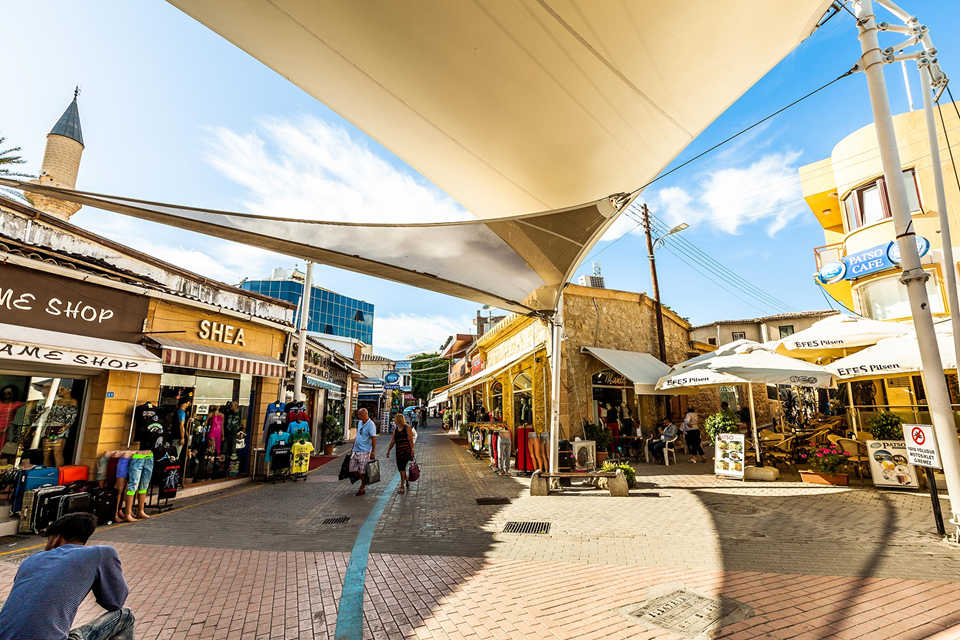
The most interesting part of Nicosia is the circular, about 1.5 kilometer in diameter Old City, through which the Green Line runs in a crooked path through its middle as if you had taken a cookie and broken it in half. Since there is little tourist traffic in the northern, Turkish half, we'll focus on the Greek southern half. The star-shaped wall of the Old City still stands, with much of the moat having been converted into a circular park wrapping around its circumference.
The streets and paths of the Old City are very narrow, and crammed with shops of all kinds. There is a lively, youth-centered cafe and entertainment scene. Scattered mosques, churches, and palms trees give the city a pleasant, Middle-Eastern flavor. There are many restored, balconied homes, crafts and arts shops, tavernas and outdoor cafes. Cultural events such as concerts and exhibitions take place in the moat park or at the restored, Venetian-built Famagusta Gate, the chief gate of the Old City. Some buildings are in disrepair as you get closer to the Green Line.
Famagusta Gate is a copy of the Lazaretto Gate of Candia (Venetian-era Heraklion, Crete). The gate, dating from the mid-16th century, is essentially an opening through the earthen rampart of the city's defenses. The vaulted passageway has a dome in its center with a round opening admitting light, like Rome's Pantheon. The passageway is wide enough for two-way traffic. During Ottoman rule only Turks could come through the gate on horseback. A number of side doors, now walled up, led to storage chambers. The British used the gate's interior for storage. Its use as a storage facility was abandoned because of problems with humidity. Vast improvements dating from 1980 have resolved the humidity problems and the Gate, which can be thought of as a long, narrow room, has found new life as a cultural center, which has led to an overall renaissance of the Taht-el-kale, a medieval quarter of the Old City of which the Gate is a part.
The Venetian Walls
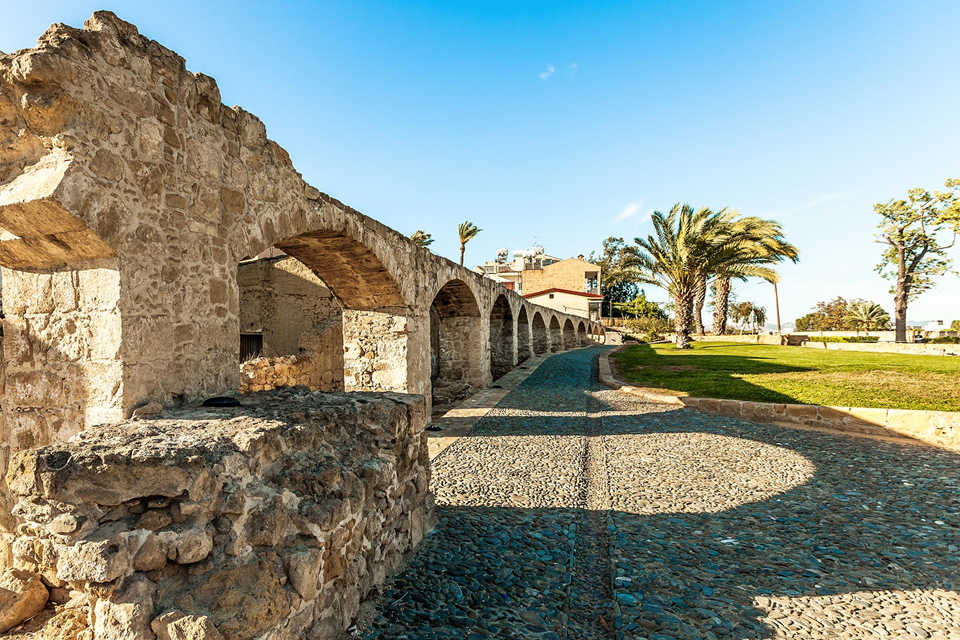
The Venetian Walls are high and broad enough to be walked while giving you a great view of the city. Paphos Gate and the Roccass Bastion give you a good view of the UN Buffer Zone, which narrows down to about 200 meters at this point. The Buffer Zone in Nicosia is a scar on the city, an uninhabited ribbon of land full of abandoned buildings which are slowly falling apart.
The Mansion of Hadjigeorgakis Kornesios was home to the family of that name during the 1790's and early 1800's. Kornesios was a dragoman, a go-between for the Turkish rulers and Christian citizens. The mansion, now a museum, is the finest surviving example of Ottoman-style residential architecture in Nicosia. The house is shaped like an open-ended rectangle with a portico around its 3 inner sides, and a fountain in the courtyard the rectangle encloses. Inside, it preserves an Ottoman home of the upper classes in every detail.
The recently renovated and restored Laiki Geitonia is a quaint neighborhood with footpath-narrow streets and alleys full of small shops selling tourist items, paintings, t-shirts and postcards, as well as having some excellent small restaurants and cafes. There are boutiques and art galleries, with a free, bohemian like atmosphere. It resemble The Plaka in Athens. The buildings are old, predominently stucco and timber, with overhanging balconies shade the streets. It is the focus of tourism in Nicosia.
Churches
The Church of the Archangel Michail Tripiotis has 3 naves with vaulted ceilings and a central dome mounted on an octagonal base. An interior inscription dates work on the church from 1695, which is likely the date of restoration work conducted on a slightly older church. Since the Turks were in charge of things in that year, it's a bit unusual that they would permit any work at all to go on. The church has some beautiful icons.
St. John's Cathedral was built in 1662 on the site of a Catholic Benedictine monastery which was abandoned in 1426 because of Mamluk (Egyptian) raiders, at which time it became an Orthodox monastery. Built with a view to house Nicosia's archbishop, the single-vaulted, dome-less church is known for its beautiful frescoes dating from the mid-1700's. Despite its small size, St. John's Cathedral is the official state church of Cyprus, which means that all religious ceremonies of national import take place there, usually with the President of the Republic of Cyprus and the Greek ambassador in attendance.
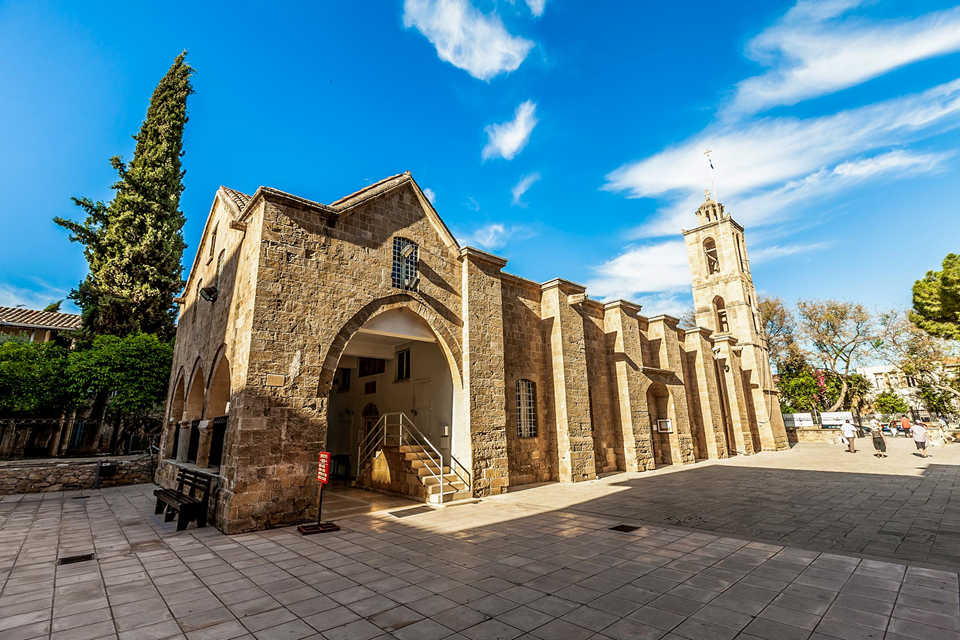
The church of Panagia Chrysaliniotissa, close to the Bishopric (the center of Orthodoxy on Cyprus), is the oldest surviving Byzantine-era church in Nicosia. Church layout has been altered over the years with several additions. It has an extremely well-rendered wooden iconostasis with very detailed woodcarving. It was home to many finely executed icons which are now on display in the Byzantine Museum.
Faneromeni Church and Faneromeni Square, in almost the exact center of Nicosia, was Nicosia's central church and square before the city was divided. Built on the site of a very old nunnery in 1872, Faneromeni Church shares its Square with the Faneromeni School (the first all-girls' school in Cyprus), the Faneromeni Library, and the Marble Mausoleum (which contains the remains of 486 Cypriots executed by the Turks on July 9, 1921).
Mosques
Selimiye Mosque is North Nicosia's chief landmark and its most prominent religious building. If it doesn't look like a mosque, that's because it started out as a Gothic-style cathedral finished in 1326 after 78 years of construction. It is the largest and the oldest house of worship of its style on the island. The Ottomans converted it to a mosque in the 1500's after their conquest of Cyprus. The Gothic arches and columns of the immensely high-vaulted interior has been combined with the complete lack of ornamentation consistent with Islam's ban on religious imagery, creating a beautifully stark, white, arched space paved with red carpeting. About 5 minute's walk from the Ledra Street crossing, the mosque observes a dress code (head scarves for women, no shorts or bare shoulders).
Omeriye Mosque is also near the center of the old walled city, this time south of the Green Line. The mosque was originally a 14th century church belonging to Augustinian monks and dedicated to the Virgin Mary. The roof and upper portion of this formerly 15 meter-high building was demolished by Turkish cannon fire during the siege of Nicosia in 1570. The Ottomans refurbished the church, including paving some it with tombstones with French inscriptions. They named it after a 7th century prophet named Omer who, tradition says, stopped in Nicosia on his way to Egypt and slept on the church's porch.
Next to the Omeriye Mosque are the Omeriye Baths, or Hamam Omerye (or the Hamam Omerye Baths, which is redundant since "hamam" is Turkish for "baths."). It dates from the 1300's when it was the Augustinian church of St. Mary. The baths have been restored and are actually functioning as a public bath, more of a spa really, with massages on offer. Its domed interior is beautifully lit to bring out the richness of the sandstone walls and the gothic arches.
Batraktar Mosque is built hard against the interior wall of the Constanza Bastion, one of 11 such bastions in the old defensive walls, and the spot where the Turks first climbed into the city when it fell in 1570. A Turkish soldier named Batraktar was the flag-bearer, and was cut down as soon as he got into the city. He was buried where he fell. The victorious Ottomans decided to build a mosque in his honor on that spot. Because of its symbolic significance, the mosque was the site of sectarian attacks during the middle 1960's. The Greeks bombed the mosque, as well as the nearby Omerye Mosque. In a January 22, 1964 attack the minaret was toppled. After remaining closed for 39 years, the mosque was re-opened in 2003.
Museums
The Leventis Museum, on Ledras Street, Nicosia's main drag, in the Laiki Geitonia, houses all kinds of stuff from the collections of Anastasios Leventis, his foundation, and other donors. Opening in 1989 as Nicosia's first historical museum, it tracks Nicosia's history as a settlement going back to 3,000 BC. The exhibits are arranged in a beautifully restored neo-classical building in such a way as to take you back in time starting with the present era. Artifacts include jewels, furniture, engravings photos, archeological items, and costumes.
The Cyprus Museum, established in 1882, is the largest and oldest archeological museum on the island. Located in a cut limestone building with a classical portico just outside the Old City's city walls to the southwest (but still in the center of greater Nicosia), the museum is a treasure trove of artifacts from all over Cyprus. Cypriot citizens and leaders, both Christian and Muslim, petitioned the British-led government for an archeological museum in 1881. An impetus for the petition was the recent looting of and smuggling ancient artifacts from the island.
The museum has 14 rooms following chronological order. Dating of artifacts start with religious figurines carved out of the mineral picrolite from the Chalcolithic period (3,000 BC). There are also clay objects of worship. Other rooms are dedicated to an extensive pottery collection, and the evolution of pottery over several thousand years. There is a room with hundreds of clay figurines and larger statues which were found around an ancient altar. There is statuary from the pre-classical and classical periods, and clay tablets displaying the history and development of writing on Cyprus. Museum is closed on Mondays but open the other days of the week.
The Ethnographic or Folk Art Museum contains samples of Cypriot folk art from the 19th-20th centuries. These include weaving, pottery, embroidery, woodcarvings, metalwork, leatherwork, agricultural tools, and ethnic costumes. It is housed on the premises of the Old Archbishopric, a building dating from the 15th century.
Nicosia is a fascinating, tragically divided city, and a must-see for any visitor to the sun and sea on Cyprus's coasts.