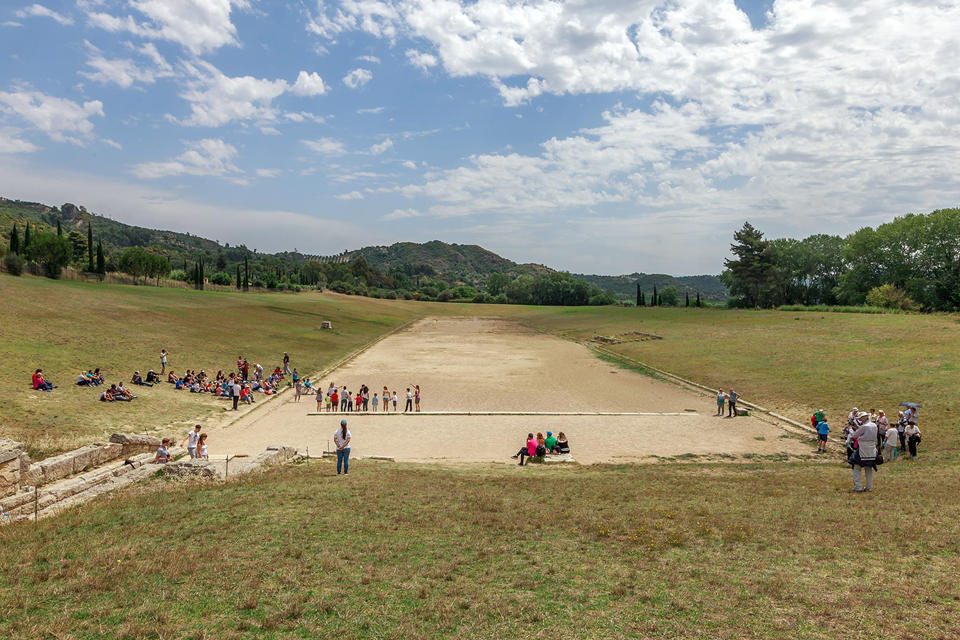
It is a strange place in the middle of a grove in the middle of nowhere which affects the spirit in a sometimes unsettling way. It is a place where one can almost hear the roar of the crowd in the now grass lined slopes of the stadium, where many gods were worshipped for thousands of years by many thousands of people.
Those gods, and those people, have left their imprint on this glade at the confluence of two small rivers, a sort of shadow presence even now, a millennium and a half after the monuments and temples disappeared, destroyed either by looters or earthquakes, this place of worship to pagan gods gradually buried under the silt and debris of the repeated overflow of the two small rivers.
Olympia was the most celebrated sanctuary in Ancient Greece. Dedicated to Zeus, it lies 45 miles (72 km) south of Patras, in the Peloponnese, in a beautiful vale on the southwest foothill of Mt. Kronos, where the small Alpheios and Kladeos rivers meet. First ruler of the region was Pelops, a legendary figure from whose name the Peloponnese was taken.
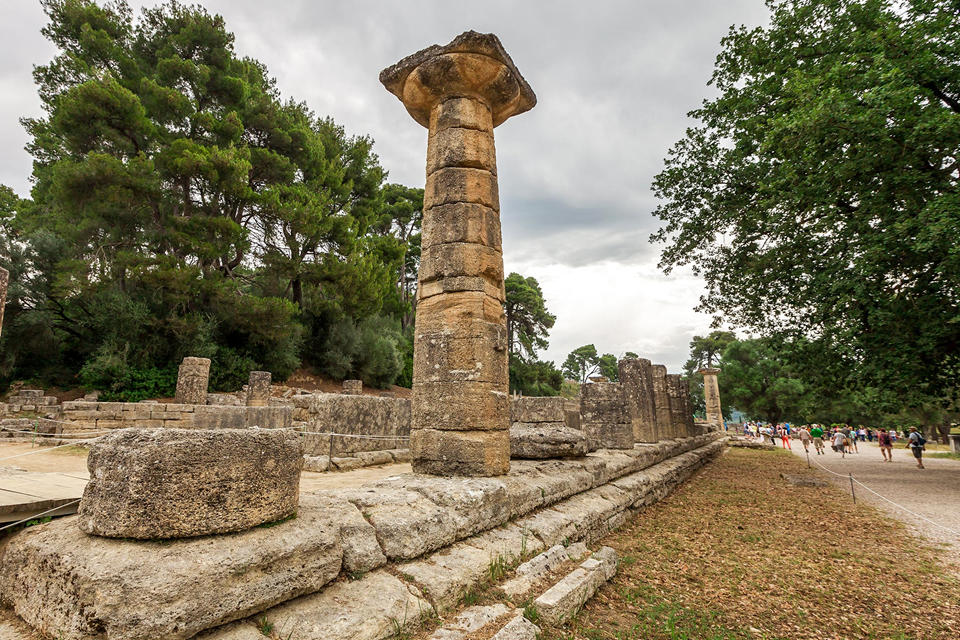
The area was inhabited as far back as 4,000 BC. The Altis, the sacred, walled area where the various temples were built was established about 1,000 BC. This is a green area shaded by oaks, pines and olive trees. At this time the cult of Zeus was established. For many centuries it was a place dedicated only to worship. The first monumental buildings were constructed, such as the temple of Hera, the Prytaneion, the Bouleuterion, the treasuries and the first stadium. The walls of the Altis enclosed the entire area.
The Olympic Games were first organized in 776 BC by rival kings of Sparta and Pisa to honor Zeus. A truce was declared for the duration of the Games. This festival, held once every four years, gradually grew in fame, and added participants, until all city-states of consequence would lay down their arms and send a contingent of local athletes to the Games.
More buildings were constructed. The huge temple of Zeus was built between 470-456 BC, along with several other temples, stoas, outbuildings, and treasuries. The stadium was then moved outside of the Altis.
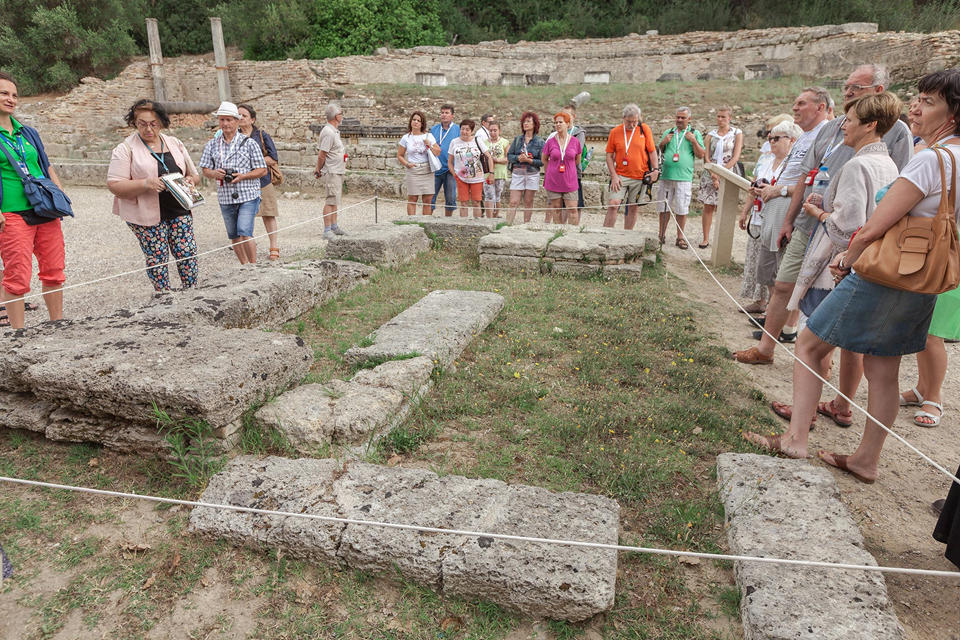
The first Games lasted only a day, with only one event: a footrace from one end of the stadium to the other. In time the Games were held over a four-day period, with other events added such as wrestling, boxing, long jump, throwing the javelin and discus, and chariot racing.
Many of the Temples, treasuries and statues were pillaged after the Roman conquest of Greece in 146 BC. The Romans also refurbished many buildings, and built new ones, including hot baths, mansions, and an aqueduct. The Romans decorated their villas with statues and treasures from the sanctuary.
When Constantine the Great declared Rome a Christian empire, the Games' days were numbered, although they continued during his rule. The last Games were held in 393 AD, after which Theodosius I banned them. Many buildings were subsequently damaged by earthquakes. After that the Alpheios and Kladeos rivers repeatedly overflowed, burying the site, over the centuries, with silt and debris about 20 feet (6 meters) deep.
The ancient sanctuary was not re-discovered until 1766. Beginning in 1829 the French began to excavate the area, taking several artifacts to the Louvre. The Germans began a more systematic excavation in 1875, which continues to this day.
The Archeological Museum of Olympia is one of the best of its kind in Greece, featuring excavated finds dating from pre-history up till the early centuries of the Christian period. It is most famous for its sculpture collection, and has the richest bronze collection in the world.