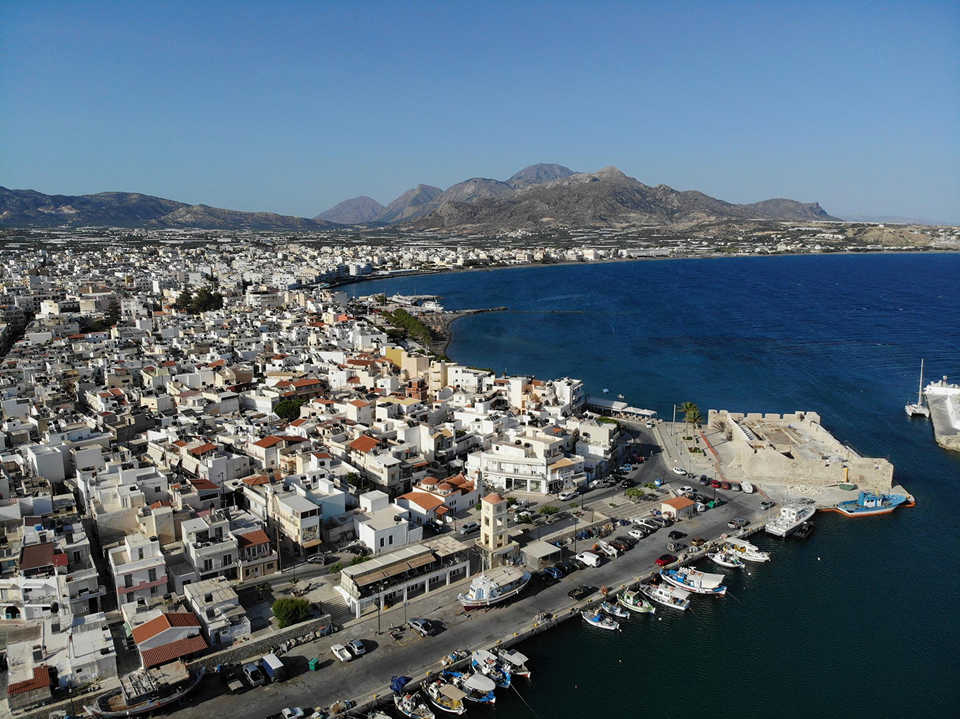
Ierapetra, the only city on Crete’s underdeveloped south coast, is a picturesque, out-of-the-way place, preserving much of the character of Crete before its decades-long tourism boom. Fourth largest city in Crete, Ierapetra is still small (pop. 17,000, 27,000 metro.) by most standards. The Roman era geographer Strabo accurately wrote that Ierapetra was at Crete’s narrowest point. It’s towards the eastern end of the island, due south of Agios Nikolaos. Crete is only 12 km wide at this point. Ierapetra is not only the southernmost city in Greece, it’s also the southernmost city in Europe.
Ierapetra has the warmest winters in Greece, and, with 300 days of sun, is Greece’s sunniest locale. Swimming season stretches through November (with sea temps still 20 C or 68 F), and begins in late April for the hardy. The Libyan Sea here never gets below 16 C or 61 F. That makes it easy to swim year round if you can handle the cooler temps. It’s an ideal destination for an September holiday.
History
Since the Minoan era (3,000-1,100 BC), Ierapetra had been one of Crete’s most significant ports, handling trade from Egypt and the eastern Mediterranean. It has also been considered a sacred place for millennia. The prefix “Iera” in its name means “sacred,” and the suffix “petra” means “stone.” Before the name Ierapetra took root, the settlement was known as “Hierapytna,” or “sacred hill,” so named for a now nonexistent temple of the hill’s summit. Archeological remains of the ancient city have been covered by the modern city.
Interestingly, the temple was not dedicated to any of the classic Greek mythological deities, but to a Greco-Egyptian syncretic god named Serapis. Serapis was not your typical two-dimensional animal-headed Egyptian god, but instead was presented as a grave, dignified man with a full beard. He was a combination of the Egyptian god Osiris (the green-skinned god of fertility) and Apis, (the sacred bull who acted as intermediary between men and gods).
The reason for Serapis’ distinctly Greek appearance was that he was promoted in the third century, BC by the then ruler of Egypt, Ptolemy I Soter, one of Alexander’s four generals who had divided up the Macedonian conqueror’s vast empire upon his untimely death in 323 BC. Serapis was promoted in the Mediterranean basin by various rulers for centuries and remained popular well into the Roman era.
The Romans, recognizing Ierapetra’s commercial and military value, came along in 66 BC and invested heavily in public building projects including an aqueduct, two theatres, temples, baths, and monuments. The remains of the Roman harbor can still be seen in the shallow waters off Ierapetra.
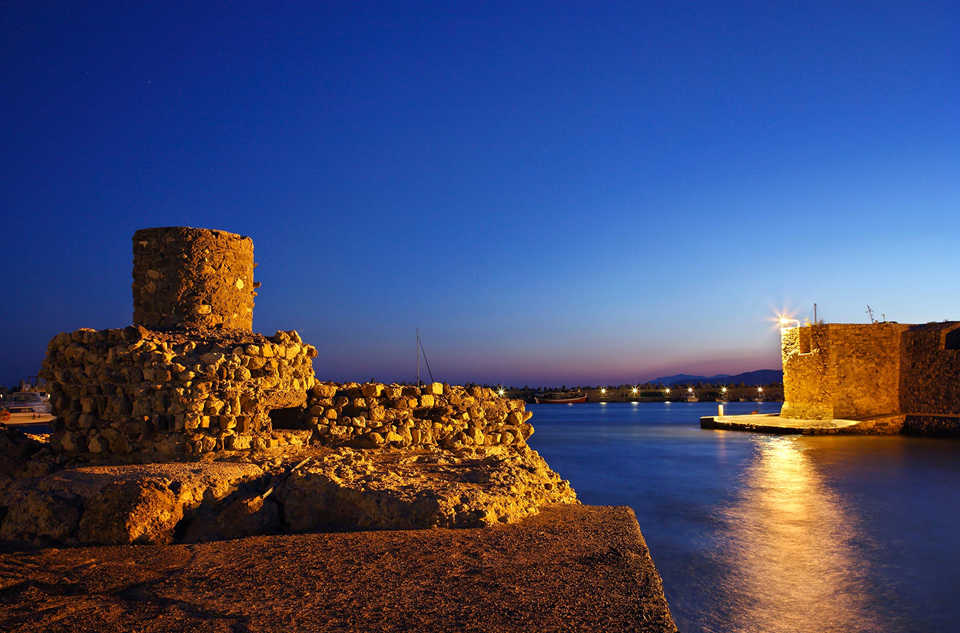
They even built a Navmachia (“nav” = “naval,” “machia” = “battle”), a body of water where naval battles were re-created for public entertainment. Navmachias were instituted by Julius Caesar, and were built throughout the Roman Empire, but not so much in Greece. At Ierapetra, the Navmachia was a small inland lake connected to the sea by a narrow waterway.
Christianity was established in Ierapetra in the first century by Titus, a Cretan discipled by the Apostle Paul. Before becoming Bishop of Crete, Titus served for a time as St. Paul’s secretary and amanuensis. St. Paul dictated his Second epistle to the Corinthians to Titus, who then hand carried the epistle to the Corinthian church. Titus is now a saint in both the Eastern Orthodox and Catholic faiths.
Because of Ierapetra’s strategic location, it retained military and commercial importance throughout the Byzantine era, but was frequently the object of attacks by other powers. Saracen Arabs took the city in the 9th century. They destroyed it, rebuilt it, and then used it as a base for pirates. The Venetians arrived in the 13th century made the city prominent once more, and built the Fortress of Kales. The Ottoman Turks conquered Ierapetra in the 17th century. In 1798 Napoleon spent the night in Ierapetra with a local family on his way to his Battle of the Pyramids in Egypt.
Ierapetra’s importance waned in the subsequent centuries, on into the reconstituted Greek state after Crete’s liberation and absorption into modern Greece around the turn of the 20th century.
Paul Kuypers (pronounced (“Coopers”) arrived in 1966. A Dutch agriculturalist, Kuypers instituted greenhouse agriculture in Ierapetra, which allowed the export of early fruit and vegetables to European markets. Eventually his methods were adopted widely in Crete, and comprised an agricultural revolution in the island. Today, greenhouse farming is Ierapetra’s largest source of non-tourist income. There are nearly 4,000 acres of these greenhouses surrounding the city on all three sides. Kypers died in a car accident near Ierapetra in 1971 at the young age of 31, and is memorialized with a bust west of the city.
Ierapetra Now
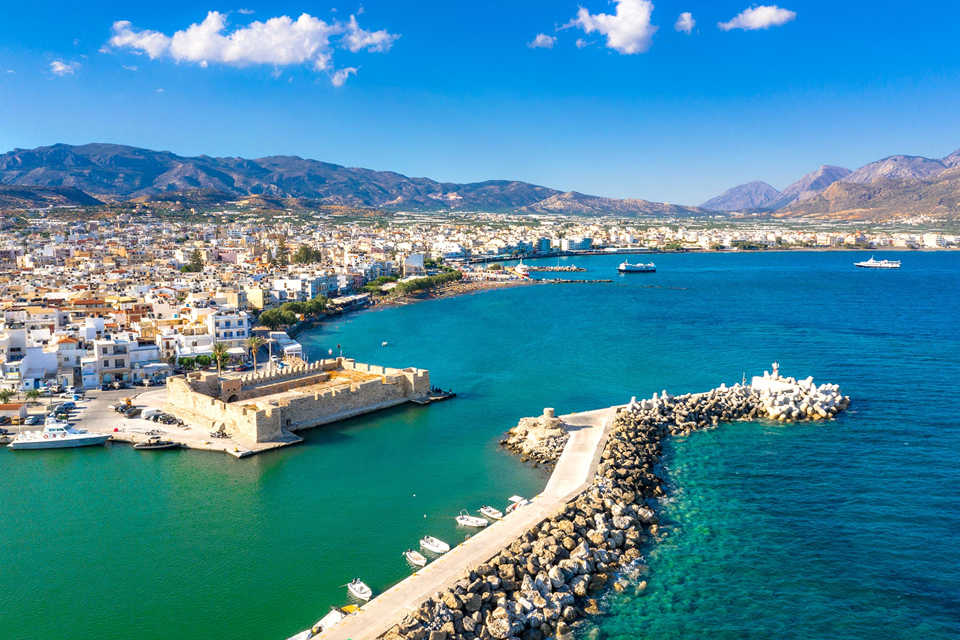
Ierapetra’s contemporary layout splits the city into two areas: The Kato Mera and the Pano Mera (The Lower Place and the Higher Place). The Kato Mera occupies the stub of a peninsula in the southwest sector of the city, a little triangular headland with an inland base about 500 m wide, running east-west; it’s another 500 m from the base south to the point of the peninsula jutting into the sea.
The Kales Venetian Fortress occupies this seaward point, and oversees a snug little seawall-protected harbor curling into the bay and back again like a dog’s tail. If you stand at the tip of the tail, you get a nice panorama of Ieraptra and its waterfront, with the squat Venetian fortress 30m away, across the narrow mouth of the harbor. The white buildings of the city stretch along the seafront, and the low rise of the mountains are to the north.
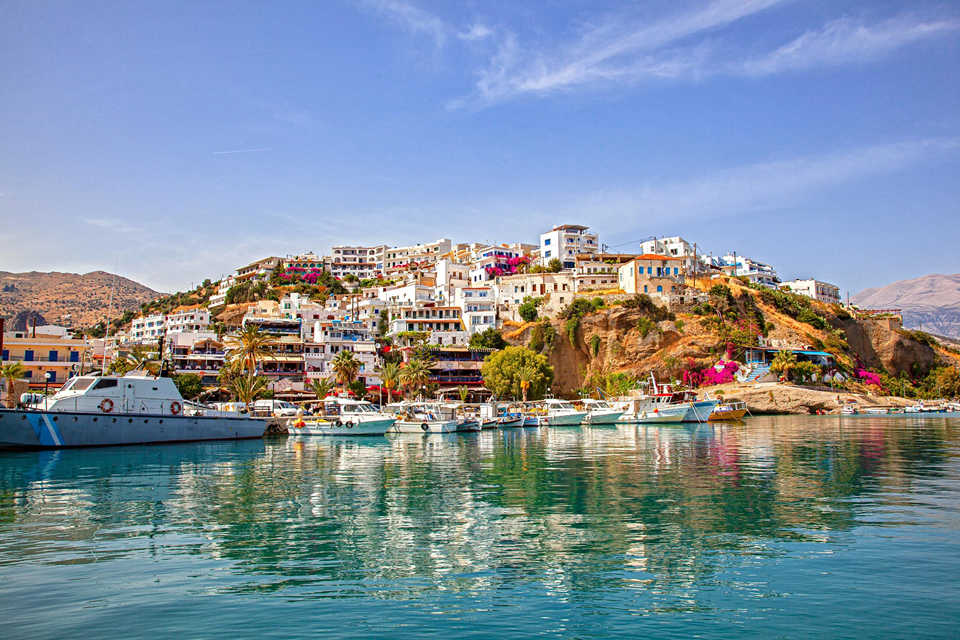
Kato Mera dates back to the Medieval era, and is characterized by the charming narrow, twisting streets, and small one and two-story houses which characterize many cities throughout Greek islands, where it’s fun just to get lost and see what will turn up. Some points of interest include the home where Napoleon spent the night (on Napoleon Street, about a hundred meters from the Kales Fortress.), and Agios Georgios church, built in 1856 on the foundations of a much older building. The fortress is a favorite location for cultural events.
The most prominent, and most-visited building in the Kato Mera is the Kales (“Kales” means “Tower” in Turkish) Venetian Fortress, which the locals claim was originally built in 1212 by a Genoan pirate named Pescatore (Italian for “Fisherman”). More grounded in history is the fact that in 1626 the Venetians upgraded the fort to make it more secure after it was damaged by an earthquake in 1508.
Pano Mera has the main shopping district, the Town Hall, the town museum, and a beautiful flagstone-paved seaside promenade with its cafes and restaurants. Ierapetra is known for the freshness of its seafood. There is a lot of beachfront right in the city, with excellent swimming in crystal clear waters.
Inland off the north end of the promenade is the Ottoman School (“Mehtepi”), built in 1899 for Turkish children just after Crete’s liberation from the Ottoman Turks. It’s a beautiful, long, one-story structure of brown, stuccoed limestone. Presently it houses the Archeological Collection of Ierapetra, with exhibits representing eras of the city dating from the Bronze age on into the 4th century, AD.
Generally speaking, Ierapetra is beautifully laid out, with lots of pedestrian walkways, and clean streets.
In The Area
Chrissi (“Golden”) Island is the favorite destination outside of Ierapetra. It’s a 15 km (9 miles) boat ride south of Ierapetra. Chrissi Island is a NATURA 2000 wildlife refuge, with over 120 species of birds which live or migrate there. The island is partially covered with short cedar trees, which lend a pleasant aroma to the area. Trekking into the interior of this small island is prohibited, but there is access to the golden sands of its beaches. Chrissi Island is known for the various shades of aquamarine of its waters. Local ferries will take visitors there, rent them umbrellas, and even serve them lunch.
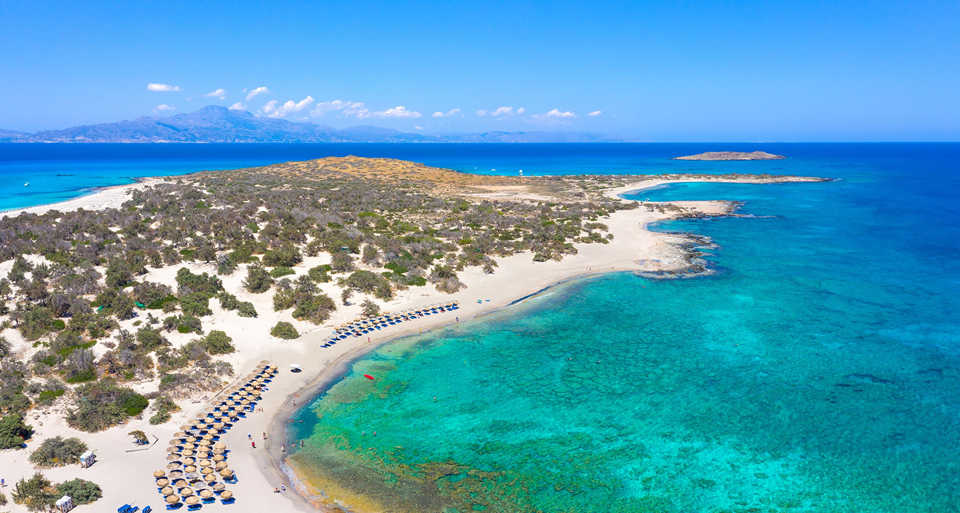
There are many beautiful beaches all up and down the coast from Ierapetra, many of them deserted.
About 20 km northwest of Ierapetra is the plateau of Selekano, which offers pristine nature, a network of forest trails, little gorges and streams, and the cultivation of walnuts, pears and grapes in its basin. Selekano is home to the 4km long Havgas Gorge, one of Crete’s prettiest and easiest to navigate. It narrows considerable as one goes along, and ends at Neraidokolymbos Lake (“Fairyswimming Lake”), which features a boulder at the foot of a small waterfall which locals say was placed there by fairies, who swam there by moonlight. There are other gorges in the Ierapetra area, but the most spectacular is the Ha Gorge, so narrow and deep that only experienced rock climbers should attempt it, although the spectacular fissure in the mountains that is the mouth of the gorge is worth the trip in itself.
Myrtos Pyrgos is a early Minoan-era (3,000 BC) archeological site on the coast about 15 km west of Ierapetra. Excavations started in 1970, and have uncovered the remains of a country house, and a tomb containing various tools and clay vases and cups in addition to stone caskets and human remains. This completely intact tomb was discovered in 2018 when a local farmer parking a car in his olive grove felt the ground give way beneath one of his wheels. The hole he uncovered revealed a 2.5m deep cavity housing artefacts and the bodies of two Minoan-era men dating from 1400 BC. A broken irrigation line had softened the soil and undermined the earth beneath the farmer’s truck.
Takis Animal Shelter, outside the city, is a well-known shelter for stray dogs and cats. Takis houses 450 stray dogs, and has a YouTube channel with over 500,000 followers.
Ierapetra is a wonderful place to visit, with its mild climate, scenic beauty, great seafood, and interesting side trips. Recently locals rejected a project aimed at dredging the harbor to accommodate large cruise ships. That was a smart choice. Here’s hoping that port never gets built. Ierapetra is only a 45-minute drive south from Agios Nikolaos, and about 80 minutes from Heraklion. That doesn’t sound like such a long trip to arrive at such a beautiful, relatively unspoiled place.