At 477.4 square kilometers (184 square miles), Samos is the 9th largest of the 30 main Greek islands of the Aegean and Ionian seas. It misses out on being the 8th largest to Lemnos by only 50 acres. It’s about 45km from east to west, and 20km north to south at its widest point. It’s in the extreme eastern part of the Aegean, just south of the center point of Turkey’s west coast. It’s less than 2km from Turkey at its closest point near Psili Ammos on the islands southeast coast. Samos is home to 33,000 year-round residents.
If there were a contest for the most number of great Greeks from antiquity who were born or stayed on an Aegean island, the winner would be Samos. It is in Samos that Pythagoras, father of mathematics, was born. Epicurus the pleasure-loving philosopher was also born there, and Aristarcus, who first proposed that the earth circled the sun. Aesop was a house slave in Samos until his master gave him his freedom. Herodotus stayed on Samos for a period of time. A lot of lesser-known, yet prominent in their time, Greeks either lived on or were from Samos.
Samos was a major player in the region at her peak (7th-5th centuries BC), with a large navy and thriving trade with places as far away as Egypt. It was famous for its wine and vineyards. It’s still full of vineyards and produces and exceptional Muscat wine. The Muscat grape, known for its sweetness, is possibly the oldest variety of domesticated grape in the world.
Today, Samos is one of the most popular family tourist destinations in the Aegean. Its large size means that its resorts and beaches are at a fair distance from each other which helps with over-crowding problems. Samos has it all- fine beaches, traditional villages, first-class archeological sites, and plenty of churches and monasteries to see for religious tourist.
Nearly half the island’s forests were lost to a massive fire in the summer of 2000. Even in the absence of organized re-forestation, the trees are coming back, ranging in size from 1-2 meters in height, located for the most part of the northern slopes of the island’s hills, while many of the southern slopes are still bare of trees.
Despite that, Samos is a fairly green island, with more than average yearly rainfall for an Aegean island, and exceptionally fertile soil. Samos is popular with artists, who find the colors of the island magnetic in their beauty. It was a favorite of hippies heading to or coming from Asia during the 1960’s and ‘70’s. The sea around Samos is rich with marine life, enabling the local fish taverns to offer a large variety of seafood. There are daily tour boats to Kusadasi in Turkey.
Samos lies on a particularly active earthquake zone and has experienced 68 earthquakes in the 19th-20th centuries stronger than 6.0 on the Richter scale. A massive quake in 1476 may have caused the then-occupying Genovese to abandon the island.
History
Samos has always been important, regionally, because of its strategic position as a crossroads for sea traffic and a stopping off place for travelers from Asia Minor and mainland Greece. People have been living there for at least 5,000 years and probably much longer. The Pelasgians, a pre-Greek people who lived in the region of the Aegean Sea, including Asia Minor and mainland Greece occupied the island as long ago as 3,000 BC. They instituted the worship of Hera, goddess of hearth and home and wife of Zeus. Samos is considered the birthplace of Hera.
Samos has had several name changes over the millennia. One theory as to its current name is that it came from the Phoenician for “a place up high.” Its highest point is Mt. Kerkis, at 1400 meters. This mountain, and the massif of Mt. Ambelos (1095m) are an extension of the Mycale mountain range on Asia Minor.
A mythological king of Samos was Angaeus, one of the Argonauts. He is supposed to have gathered colonists from different areas of Greece, founding a settlement there in 1360 BC. He is said to have built a wooden temple housing a golden stature of Hera. Ten years later he joined the Argonauts in their search for the golden fleece.
Samos, it is believed was settled by Ionians from Epidaurus in Argolia, the Peloponnese, sometime after 1,000 BC. Samos later became one of the 12 members of the Ionian League, a confederation of Greek Asia Minor city-states. By the 7th century, BC, Samos had achieved considerable prominence, becoming a significant center of commerce in Greece because of her advantageous position astride sea and land trade routes.
Samos also had an extensive trade network stretching from the Black Sea to Egypt, and to population centers on mainland Greece. This created tensions with nearby Asia Minor rival Miletus, eventually leading to war. During this time Samos invented a critical weapon that would be used by the Greek navy for centuries: the trireme, the three-tiered, man-powered warship known for its speed and maneuverability. Samos lost the war, but it left Miletus exposed to threats from larger powers on Asia Minor during the 6th century, while Samos stayed relatively isolated and protected.
Samos reached its peak in the later decades of the 6th century, sometimes after the Tyrant Polycrates took over the island in 538 BC. Polycrates was an “enlightened” tyrant, in that he sought the common good for the Samians and other islands and lands he conquered, such as Miletus and Ikaria, during his reign. Polycrates committed funds to extensive public works, and beautified Samos with the graduates of a school of sculptors, metal workers, and engineers. It was during this time that the Kouros of Samos, the largest (5.5m tall) Kouros ever found, was carved. (It’s displayed in the Samos Archeological Museum).
The Eupalinos subterranean aqueduct, named after its chief engineer, is considered a masterpiece of ancient engineering. It was created at this time. It was an over 1km-long tunnel through the limestone of a foothill of Mt. Kastro which provided and unlimited supply of fresh water to Samos Town, the capital, in case of siege. It was one of the first tunnels started at both ends simultaneously.
Polykrates was assassinated in 522 BC and the Persians conquered the island and enslaved art of the population. Samos revolted 23 years later as part of the Ionian Revolt, which led to the Persian Wars which lasted on and off until 450 BC. The Samians got free of Persian rule in 479 BC.
From 431-404 BC Samos sided with Athens against Sparta in the Peloponnesian War. After some time under the authority of Alexander the Great and the Ptolemies of Egypt, until the Romans came and added Samos, in 133 BC, to the Roman province of Asia. Samos joined Mithridates, the so-called “poison king,” in his ultimately unsuccessful rebellion against Rome in 88 BC.
In the early Christian era the Byzantines (originally called the Eastern Roman Empire) assumed control of Samos. Roman Traveler Lucius Apulius visited Samos in the 2nd century, AD, and mentioned its many vineyards and that the ancient temple to Hera at Hereon, which was still in good repair.
The Genoese came in 1346 and ran the island for 200 years, after which the Ottomans took over in 1475. About this time piracy became a huge problem in the Aegean largely because of the loose way the islands were governed by the Ottomans; there was little direct oversight as long as the islands paid their taxes. Samos was also hit by the plague. These events greatly de-populated the island during the 1500’s, and it remained nearly deserted for a century. The Ottomans then began to exercise greater control over the Aegean, worked on the piracy problem, and re-populated Samos beginning in 1565.
In the middle of the 16th century, Samos was settled by Greek populations with special privileges were given by the sultan, and which privileges established some kind of self-government under the rule of the Sultan.
The sultan gave the island to Kilic Ali Pasha, admiral of his navy, who was actually born in southern Italy as Giovanni Diongi Galeni and began life as a privateer. He began to re-settle the island with Greeks, Peloponnesian Arvanites (Albanians who migrated to Greece in the Middle Ages), Ionian islanders, and original Samians who had gone to Chios. attracted them with concessions: no taxes for 7 years, almost total local autonomy, and a lump sum payment to the Sultan rather than a fixed tithe (10%). Slowly the population increased to about 10,000 in the 17th century, during which time many of Samos’s modern villages were founded.
After a brief time under the Russians in the 1770’s as an outcome of the Russo-Turkish war, Samos revolted against the Turks, as did mainland Greece, in 1821. The leader of the revolution on Samos is the now-revered Lykourgos Logothetis, son of a local ship owner.
The borders of the new Greek state in 1830, at the conclusion of the war, did not include Samos.
In 1821 the island revolutionized having as leader Logothetis Lykourgos and acquired its freedom, but in 1830 when the independence of the Greek state was recognized, Samos was not included within the limits of Greece. Samians continued fighting for their union with Greece until 1834 but they didn't succeed. Instead, Samos was granted a semi-independent status and still paid tribute to the Porte (Ottoman government).
Samos finally officially became part of Greece in 1913. Just before this the old capital at Chora, near the south coast by the present-day airport, was moved to Vathy at a deep harbor on the north coast.
Italy occupied Samos during WWII, from May, 1941 to the surrender of Italy in September, 1943. After the end of the Greek civil war, in 1949, Samos, and the rest of Greece, was poor having just endured nearly a decade of warfare. Conditions gradually improved, however, especially after the Greek tourist boom began in the 1960’s. Today Samos is one of the favorite destinations of tourists to the Aegean islands.
Villages
The villages described make a counter-clockwise circle around Samos beginning at Vathy, the capital.
Vathy
Vathy/Samos is the island’s capital, and has been for about 100 years, which isn’t very long by Greek standards.
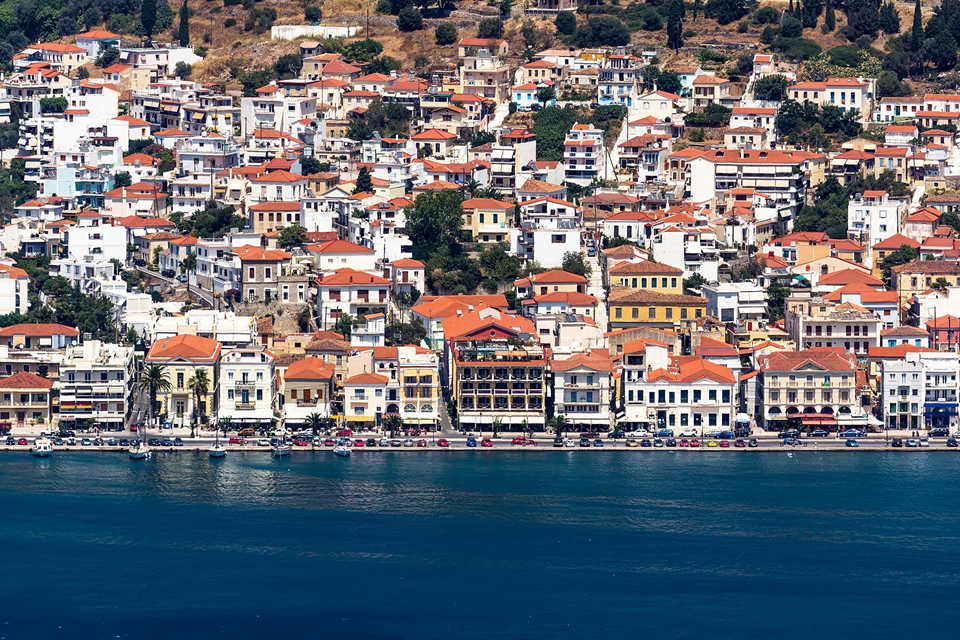
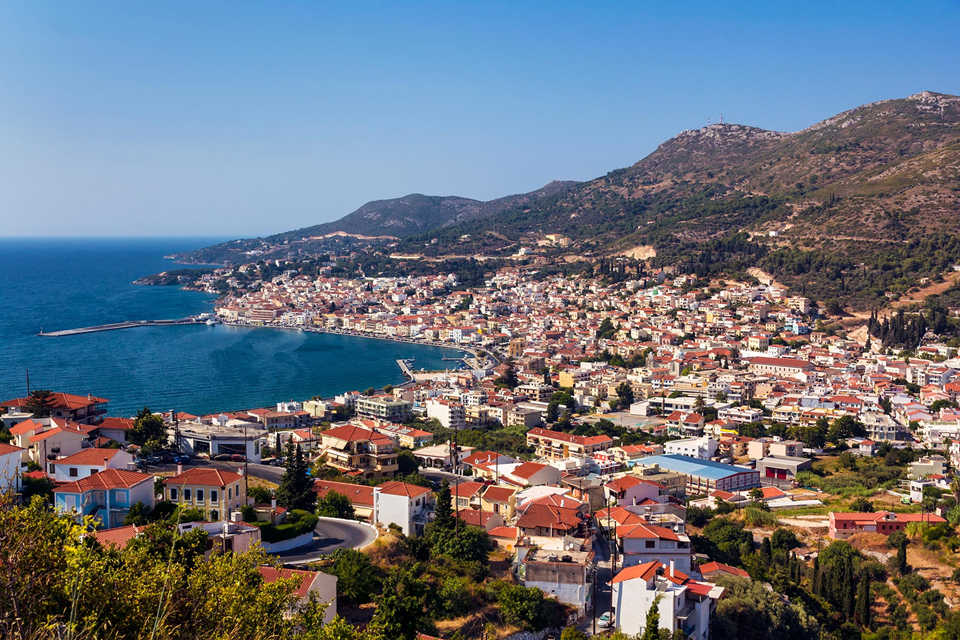
Samos is a new settlement, built along the shore of the bay and harbor in northeast Samos. Vathy, or Ano (Upper) Vathy, is about 800 meters from and 100 meters higher than the water front. Both places are interchangeably called Vathy or Samos Town. Ano Vathy’s streets are much more narrow and twisty than those of Samos. It has some nice neo-classical buildings built into the steep upgrade as it climbs away from the harbor. Rare for an island capital, there is no beach at Vathy, but it does house one of the best archeological museums in the Aegean. The Samos Archeological Museum is in a double-winged building located near the port, main park, and Town Hall. Many of its finds have been unearthed from the Heraion archeological site on the island’s south shore, where the massive temple to Hera was built. These include small objects, such as griffin heads, figurines, pottery, bronze objects and sculptures from the 5th-7th centuries BC. There are sarcophagi, columns, and kouroi, life-sized or larger free-standing statues with their enigmatic smiles, from the archaic period. This includes the 5.5-meter kouros, the largest ever found. Other attractions in Vathy include the church of Agios Spyridon and the Byzantine Museum.
Kokkari, 10km west of Vathy along the north coast, is situated among vineyards and pine trees, and is the 2nd busiest resort town on Samos. The harbor is enclosed by two rocky headlands which bookend the enclosed space and help keep the waters calm, despite the near constant winds. It’s a picturesque little village that has seen substantial change over the decades as it transformed itself into a tourist center. The beach to the west of the Kokkari is windy, which is good if you’re into wind surfing and not so good otherwise.
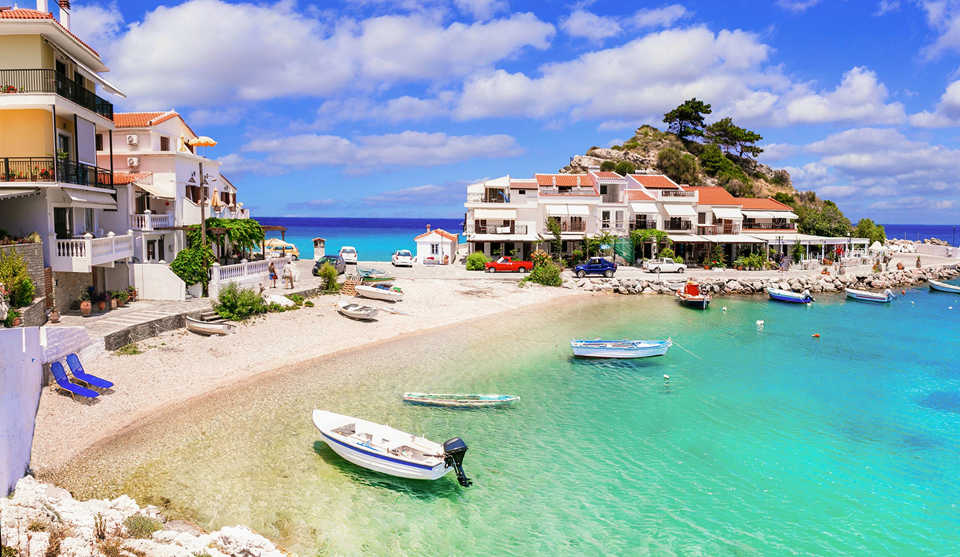
Avlakia, about 5km further west, is very small, but has a couple of very nice tavernas and a reputation for great food, and a nice, if windy, beach.
Just to the west, and inland a bit, are a trio of villages that escaped the devastating fires of 2000, and have plenty of mature trees and are connected by hiking paths. These villages are Vourliotes, Manolates, and Ambelos, all of which have magnificent views across the way to Turkey.
Karlovassi, 32km from Vathy, is about 2/3 of the way across the north coast, heading west, and is the 2nd port on the island. Its population is a slightly higher than Vathy/Samos, but it still is regarded as the second city on Samos. It’s home to the math and computer science school of the University of the Aegean, and is one of the prettiest spots on Samos. It was once a center of leather-making, an industry that has died out, but not before its more successful practitioners built some pretty nice neo-classical mansions. It has a tannery museum. At Karlovassi the main island road cuts inland to the south.
Heading south, you come to Marathokambos, 42km SW of Vathy. It’s a quiet village on the slopes of Mt. Kerkis. Its 2,500 inhabitants fish, farm, and rent out rooms. Marathokambos is couple kilometers above its port at Ormos Marathokambou, 3rd of Samos’s 4 port towns. The beach there is very popular.
Mavratzei, in the approximate center of Samos and 20km SW of Vathy, is best known as a pottery village, where all kinds of stone ware are thrown, fired, and for sale.
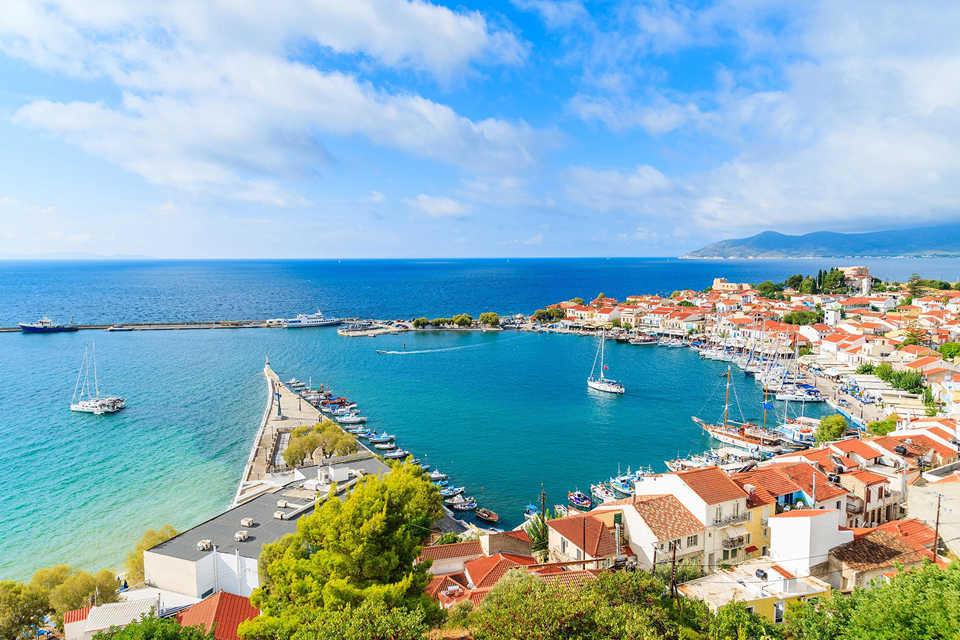
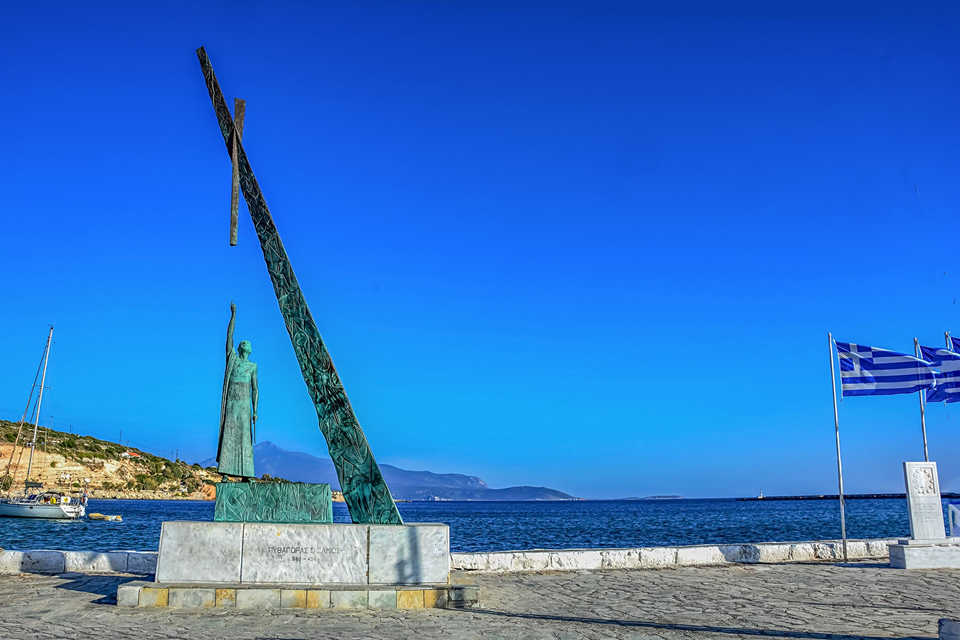
Pythagorio, 11km SW of Vathy, was built on top of the ancient town of Samos, which was built by the tyrant Polycrates. This is where the epicenter of power and influence was on Samos during it acme in the 6th century, BC. Named Tigani in the modern era, it was re-named Pythagorio in honor of its most famous citizen, Pythagoras the mathematician. It was the first resort to see development, and is the most popular resort area on the island, attracting thousands of tourists every summer. It has a beautiful little harbor and marina, and the sea here is sky blue. It has a great beach. It’s old town has attracted a lot of tourists after renovation of many old buildings. There is a very good archeological museum here. Objects include a huge statue of the Roman emperor Trajan, and a trove of 300 Byzantine-era gold coins. Pythagorio also features the over 1km-long rock hewn tunnel of the Eupalinos subterranean aqueduct, which you can visit.
Archeology
The Heraion
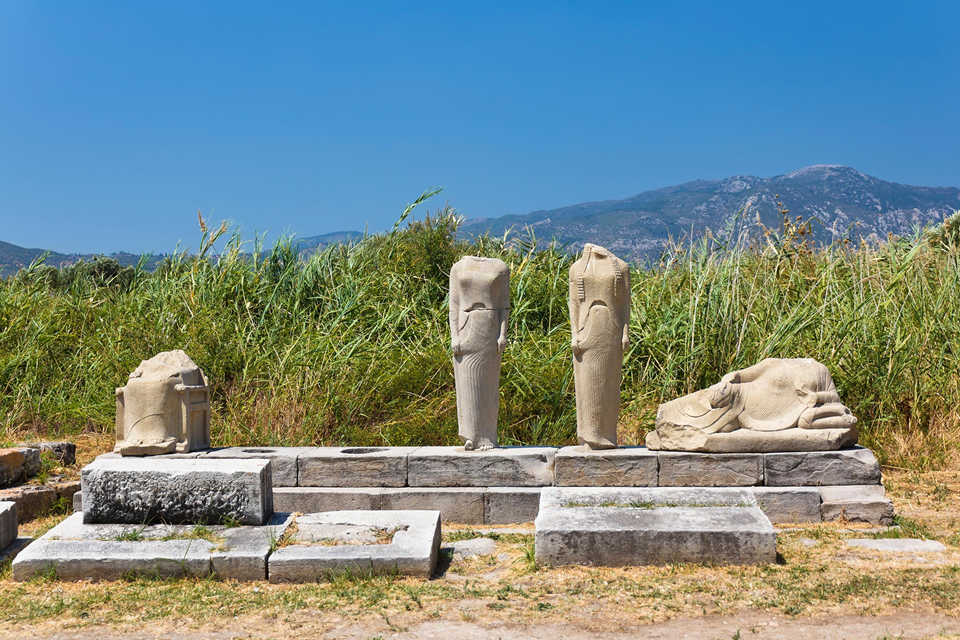
Without question the biggest archeological site on the island is the Heraion, in the approximate center of the south coast of Samos. The Heraion has been a shrine going back to at least the 8th century, BC. It was the large temple to Hera, who was said to be born and reared on Samos. Wife of Zeus and goddess of the hearth and home, Hera had to put up with Zeus’s many infidelities.
Built on the delta of an ancient, now-dry river, it was the first monumental free-standing Ionic temples (Ionic capitals are the ones that look like the two ends of a scroll.). The Heraion has been chosen as a UNESCO World Heritage site jointly with the Pythagoreion a few kilometers to the east. There’s not a whole lot left of the temple, or the site, other than a general idea of the layout of the temple complex. Most of the marble was carted away and used elsewhere, especially during the Byzantine era when it was used as a quarry. The site was first visited by a westerner, a Frenchman, in 1704. The silt from the river had covered most of the site, with was still marshy. Systematic excavation did not start until the end of the 19th century. Despite the disappearance of many buildings, the site is still well worth visiting.
The Pythagoreion
This archeological site of ancient Samos Town has several Greek and Roman monuments, such as the Roman baths, and the Eupalinos subterranean aqueduct. It also has a great archeological museum. Remains of the city wall still stand. Oldest excavated remains are found on the hill where the castle of Logothetis is. They date from the Late Neolithic Age (4th millennium, BC). Mycenaean-era tombs have been found in the area of the ancient agora. The Choma en thallassi (ancient pier of the Pythagoreion) is still in place and in use. There are also remains of a temple to Artemis near the site of an ancient Christian cemetery, as well as remains of a temple to Aphrodite.
Monasteries and Churches
The church of Agios Spyridon in Vathy is in Agios Spyridon square in the village center. This was where the decision by Samos to unite itself with Greece was made. Another important church in Vathy is the metropolitan church of Agios Nikolaos (saint of sailors).
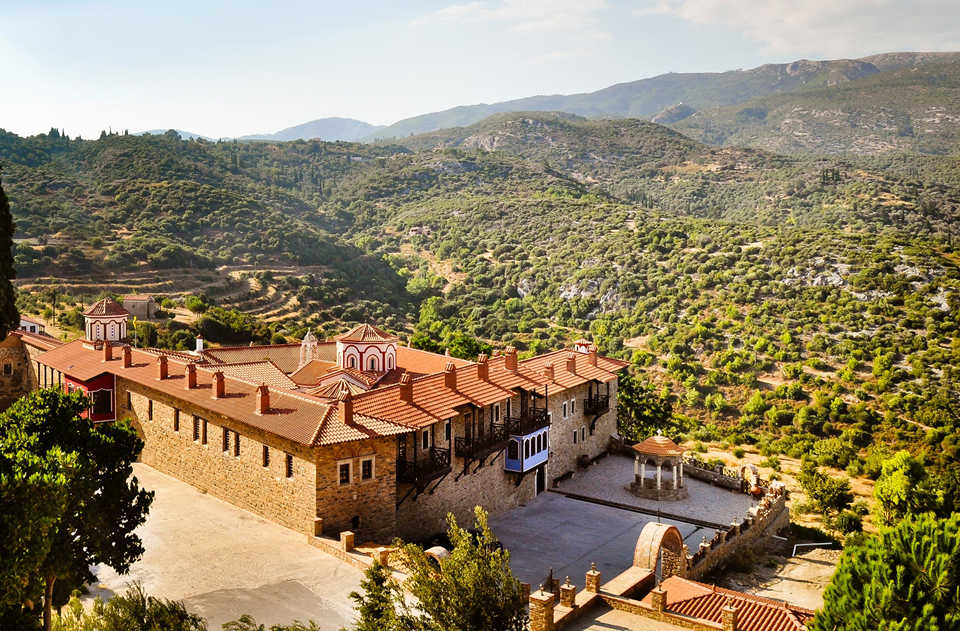
The Monastery of Panagia Spilliani (Our Lady of the Cave) is on the side of a hill behind Pythagorio. Founded in 1586, steps lead from the entrance down to a cave with a small church in its depths. The monastery affords wonderful panoramic views of the town and harbor. It is believed to have been a religious sanctuary dating from ancient times. Some people think that it was a place where Pythagoras taught.
In Karlovassi the church of the Metamorphosis (Transfiguration), near the ruins of a Venetian Castle, is one of the oldest churches on the island. Northeast of Karlovassi is the monastery of the Prophet Elijah, built in 1739 on top of an ancient chapel. Access is by hiking trail only. The trail also leads to the falls of Karlovassi.
Beaches
North Coast
Gagkou is just 2km NW of the capital, on the eastern shore of the beginning of the inlet which cuts more than 2km deep into the island and forms Vathy’s safe anchorage. This smallish (22m), pebbly beach is on a little inlet of its own, about 100m across and 500m deep. It’s close to fish taverns, hotels, and pensions. Being just outside Vathy, prices for places to stay will be significantly lower. Its proximity to the capital makes it a convenient place to stay as the interesting sites of capital are all within walking distance. And the walk is an exceptionally pleasant excursion along the seafront. As is the case with beaches close to population centers, you can find just about everything you want in Gagkou- tavernas, restaurants, and rooms to let, not to mention the nearby capital and all its attractions.
Tsamadou Beach used to be for nudists. There are still nudists there. If your vacation is a family affair, if visiting Tsamadou, a good policy is to avoid the right side of the beach because that’s where the remaining nudists hang out. Having said that, Tsamadou is one of the prettiest beaches on the island. It’s 12km northwest of Vathy along the northern coast. It’s 400 meters of pebbles and aquamarine waters which deepen sharply. You might also keep an eye out for strong northerly winds.
Tsambou, similar in name to Tsamadou, is just a few kilometers further west along the coast From Tsamadou, 15km west of the capital, and 3km before Agios Konstantinos, is similar to Tsamadou- pebbles, rapidly deepening sea, and potential for strong north winds. Tsampou is organized beach, with umbrellas and sun beds for rent. There is a tavern close by, and even a more secluded beach a short walk away?
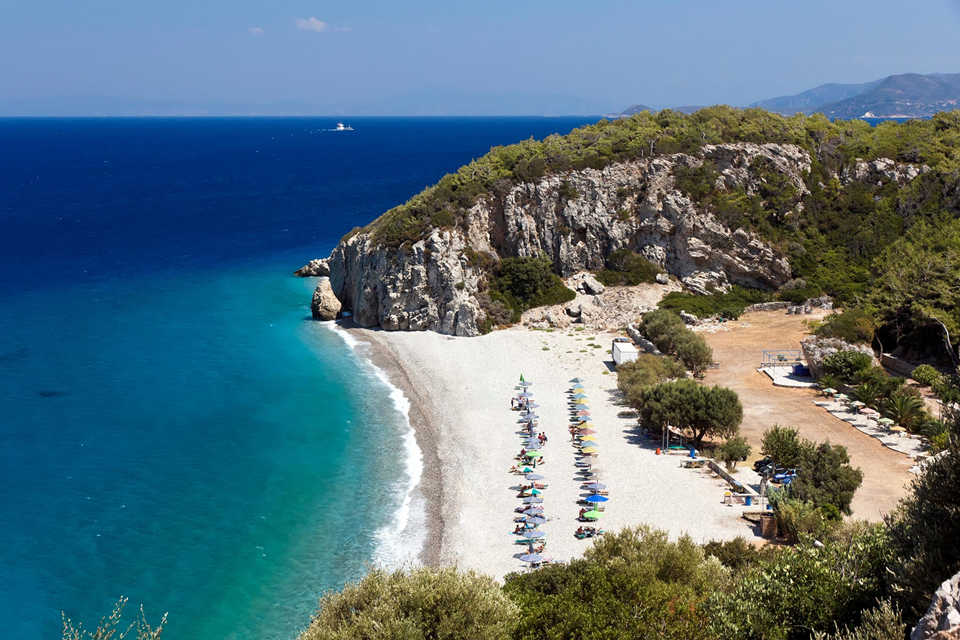
Megalo Seitani is 6km past Karlovassi, has deep, gold-colored sand and, again, a rapidly deepening sea. Megalo Seitani is a habitat for the monachus monachus the relatively rare Mediterranean monk seal. This habitat is protected by the Natura 2000 Network, an EU organization designed to recognize and preserve nature area in Europe worth saving.
Potami (River) is 34km west of Samos Town and 1.5km west of the port town of Karlovassi. This 800km-long beach is pretty much like the previous 2: pebbles, scenic beauty, deep sea, some high winds in the summer..
East Coast
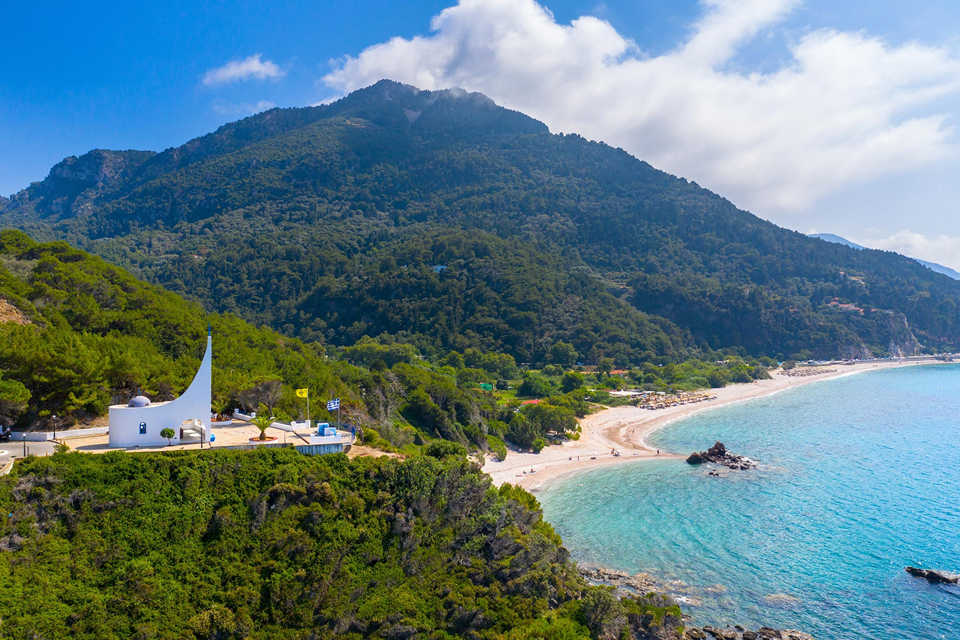
Kerveli, 8km SE of capital, Kerveli is a beach made of pebbles with shallow waters and plenty of protection from the wind. This beach on the east coast of Samos has abundant vegetation along its landward fringes. The beach is not organized, which means that is a fairly private place with few visitors.
South Coast
Generally, the south coast beaches have less wind, and lots more sand than the north.
Psili Ammos (Fine Sand) is on the SE coast of Samos, 9km south of capital. It is on the SE coast of Samos, on a stretch that runs E-W, and at only 1,200 meters, it’s the closest beach, geographically, to Turkey. It’s about 200m long, with fine sand, as the name would suggest. Its waters are shallow, completely clear, and there’s plenty of protection from the wind, as is the case with just about every south coast beach on Samos. The beach has sun beds and umbrellas, and water sports. It’s a great place for families. There are plenty of restaurants, bars, and tavernas, as well as rooms for rent. Behind the beach is the Alyki Nature Preserve, a combination wetlands and preserve for migratory birds.
Heading west, just a few kilometers away, and about 3km east of Pythagorio, is Glykoriza (Sweet-root) beach, about 10km south of Vathy. This beach is of mixed sand and pebbles, with trees around its fringe for do it yourself shade, and sun beds and umbrellas for rent if you don’t like laying around under a tree (which was a perfectly acceptable way to pass time for our ancestors.).
Potokaki’s big advantage is that it’s next door to Samos airport, which makes it a convenient place to stay for air travelers. 16km southwest of Vathy, 10 further west along the south coast from Psili Ammos, and just west of the port of Pythagorio, this 3km-long stretch of sand is one of the most popular on Samos. Potokaki is a very well organized beach with umbrellas, sun beds, and loads of water sports. Lined with beach bars, restaurants, hotels, and tavernas, the beach is so long that if you walk long enough you’ll find a secluded spot just right for you. Pythagorio is just a few minutes’ walk east.
The next beach, Kampos Marathokambou, also called Votsalakia, is a 25km jump west, bypassing off the entire massive southern bulge of Samos. Marathokambou Bay, in the southwest sector of Samos, is home to the tourist village of Ormos Marathokambou, which is the 3rd of Samos’s 4 port towns, and the inland village of Marathokambou, which is a couple kilometers inland and sits at an elevation of 300 meters.
It’s a little confusing, 3 nearly identical place names. But “Marthokambou” means “the plain of Marathon (no relation to the famous battlefield),” “Ormos Marathokambou” means “the port (or seaside) of Marathokambou, and “Kampos Marathokambou,” most confusing of all, means, “the plain of the plain of Marathon,” which accounts for its alternate name, Votsalakia.
Kambos Marathokambou is just a couple kilometers down the beach to the west from Ormos Marathokambou. The beach at Kambos Marathokambou, also called Votsalakia, is mixed sand and pebbles. The beach has sun beds and umbrellas, and the water, as always, is absolutely clean. Water sports are available there as well. There are rooms for rent either near the beach, or in the village, which is a short walk away. At the west end of the beach someone, years ago started stacking the flat stones of the beach into tapering columns two meters high and higher. They make for an unusual and interesting sight. Marathokambou/Votsalakia has a fairly lively night life scene during the high season.
Just a couple kilometers west of Marathokambou/Votsalakia is Psili Ammos West, or Chrysi Ammos (Golden Sand). The waters here are so shallow that you can wade away from shore up to 300m and still be only knee deep. Which makes it a great place for kids.
A few short kilometers down the cast to the west from Votsalakia and Psili Ammos, and about 5km before the extreme southeast tip of Samos, and 53 road miles southwest of Samos Town, is Limnionas beach. This 400 km-long beach has nice sand and some small pebbles. The beach has sun beds and umbrellas for rent, seaside taverns, restaurants, and rooms for rent.
Nature
Alyki Nature Preserve
On the southeast coast of Samos, behind Psili Ammos beach, and where Samos comes closest to Turkey, is the 43 hectare Alyki Nature Preserve, 7 of which is recently added wetland. Alyki means “salt pond” and it was once a place where salt was extracted. After the salt mining stopped in 1965, the area became a habitat for migratory birds stopping over on their way to/from Turkey. The preserve is unique in the large variety of birds which use it. In addition to 127 species of birds. Among them are little egrets, flamingos, glossy ibises, chukar partridges, short-toed snake eagles, long-legged buzzards, black-winged stilts, and whiskered terns. There are a variety of animals which use the habitat, such as hedgehogs, hares, black rats, jackals, and martens. Amphibians and reptiles include green toads, marsh frogs, pond turtles, Greek tortoises, chameleons, water snakes, vipers, and lizards.
Waterfalls at Karlovassi
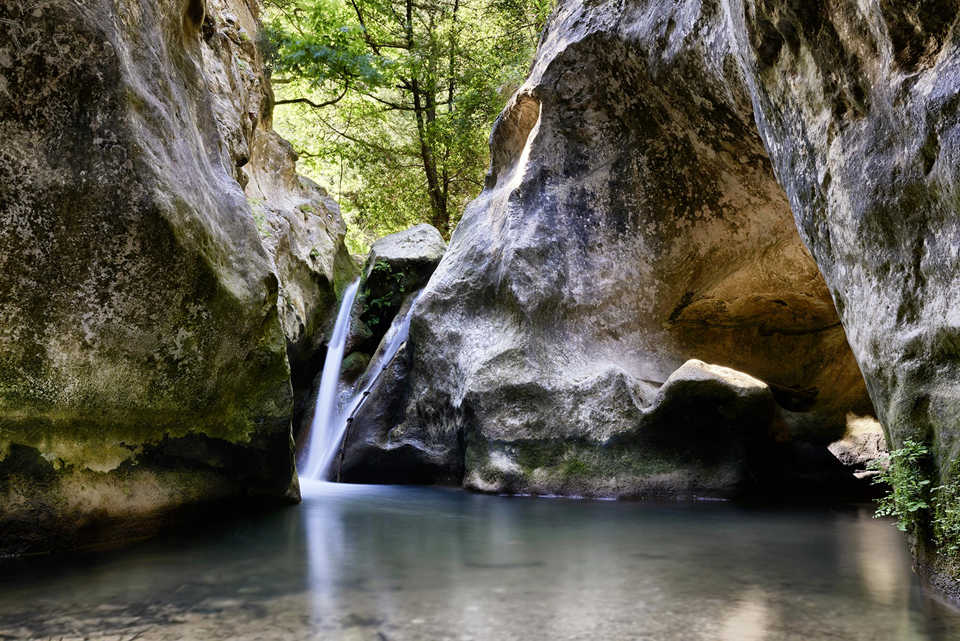
A well-marked hiking path leads you to the two falls of Karlovassi. The first one is smaller, while the second one is much higher, but still not all that high at 5m. You need to climb a flight of wooden steps to reach its top. There is a rope guide which you can use to cross the river. You can also swim at the pool at the foot of the falls.
Mt. Ambelos
Mt. Ambelos, which occupies a great deal more territory than Mt. Kerkis,spreads out on the central and eastern portions of the island. Ancient geographer Strabo wrote that “It’s the mountain that makes the entire island mountainous.” Prophet Elijah peak is its highest, at 1,153 m. The lower portions of the mountain is terraced for agriculture, a common practice n the mountainous Greek islands. There is a great deal of vegetation on Ambelos: Turkish and black pines abound. There are also a number of rare plant species.